Original visual guide
The Seven-Layer Future Watchmaking Tool Stack
A seven-layer map of how physical tools, sensing, models, decision support, control, traceability, and governance may combine in future watchmaking.
Published by Enjoy Watches · Updated August 24, 2026
Visual disclosure
Type: Original explanatory diagram. Creator: Enjoy Watches Research Desk.
Method: Source-led editorial synthesis. Labels, layout, and spatial relationships are illustrative reading aids, not a measured dataset or an inspection of a particular watch.
Evidence boundary: This original framework synthesizes the companion paper's seven-layer intelligence stack and adoption filters. It is not measured data, an engineering specification, an operating or safety procedure, or evidence that any individual workshop or manufacturer has adopted the full stack.
Cite this visual
A stable citation and asset record
Use the canonical visual page when citing or linking. The public media-kit manifest lists this visual's dated formats and canonical address.
Layers are optional, not a ladder
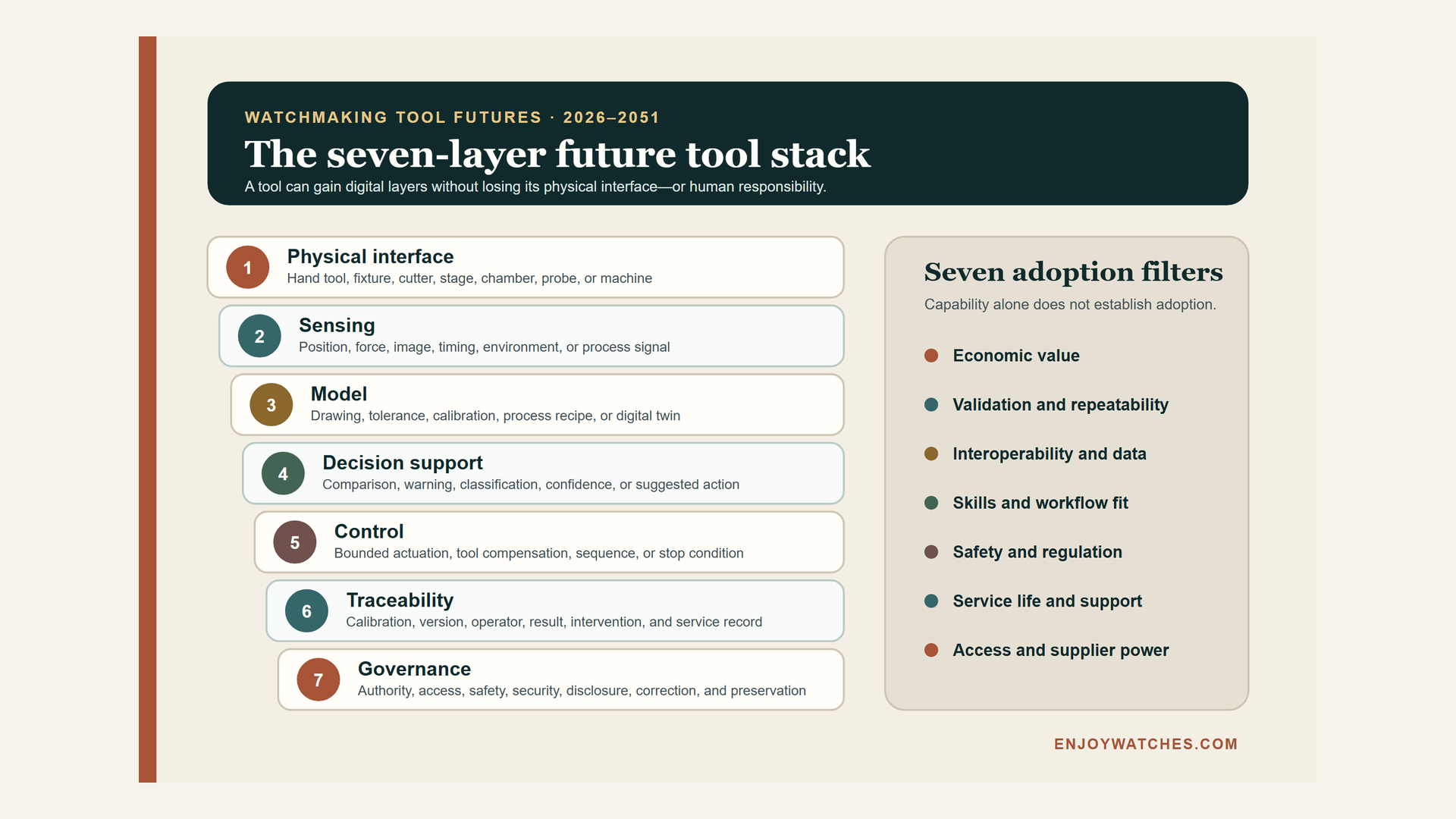
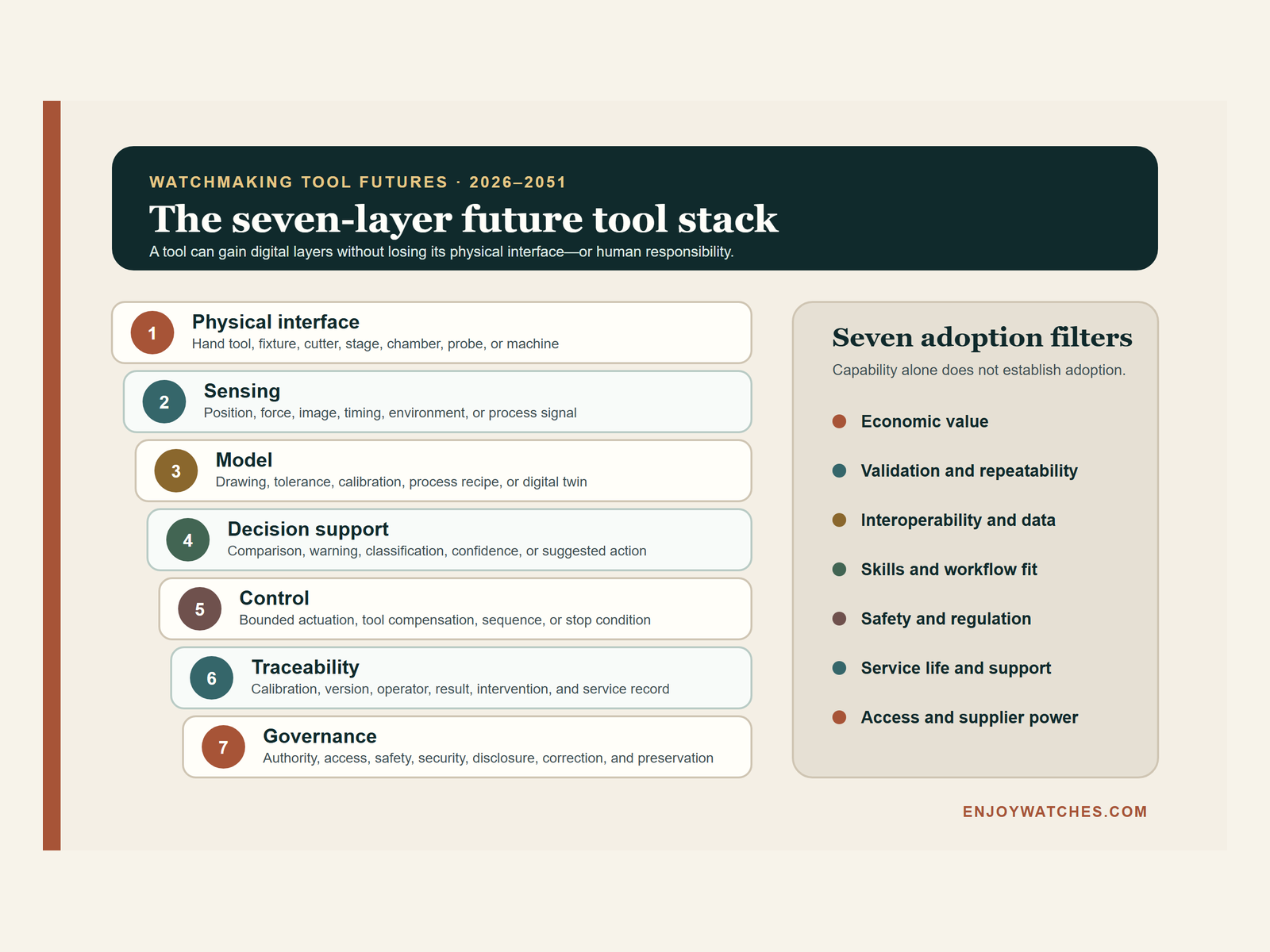
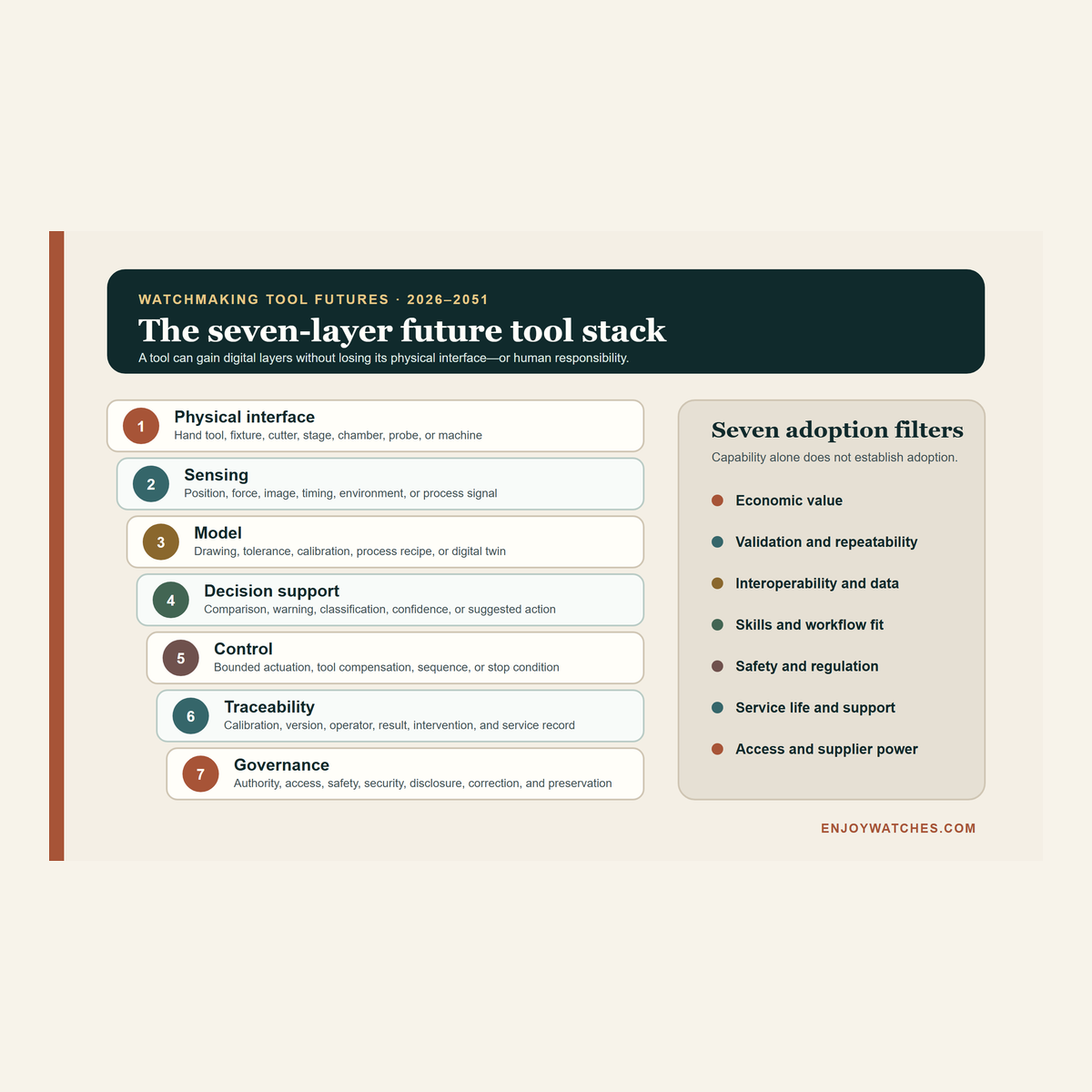
A hand tool may remain useful at the physical layer alone. A production cell may combine every layer. The diagram asks what each added layer contributes, what it depends on, who can inspect or correct it, and what happens when software, credentials, consumables, or vendor support disappear.
Capability is not adoption
The companion research separates a documented 2026 baseline from directional inference, conditional forecasts, and long-horizon scenarios. A prototype, patent, vendor page, or general manufacturing trend does not establish watch-industry deployment.
Reuse and attribution
© 2026 Enjoy Watches. You may link to this page or embed the hosted visual with its source intact. A hosted embed makes a normal image request to this site; the supplied code uses referrerpolicy="no-referrer" to avoid sending the embedding page's address. For republication, modification, print, or other reuse, request permission.
Text version of the diagram
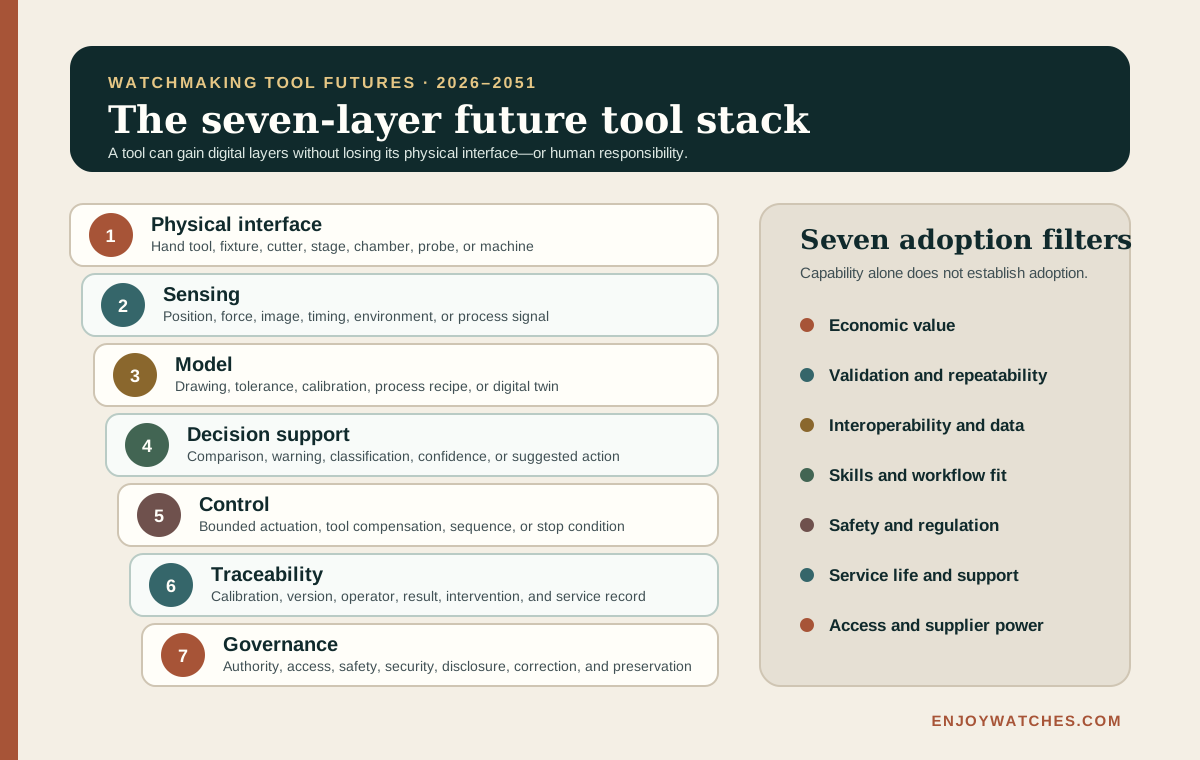
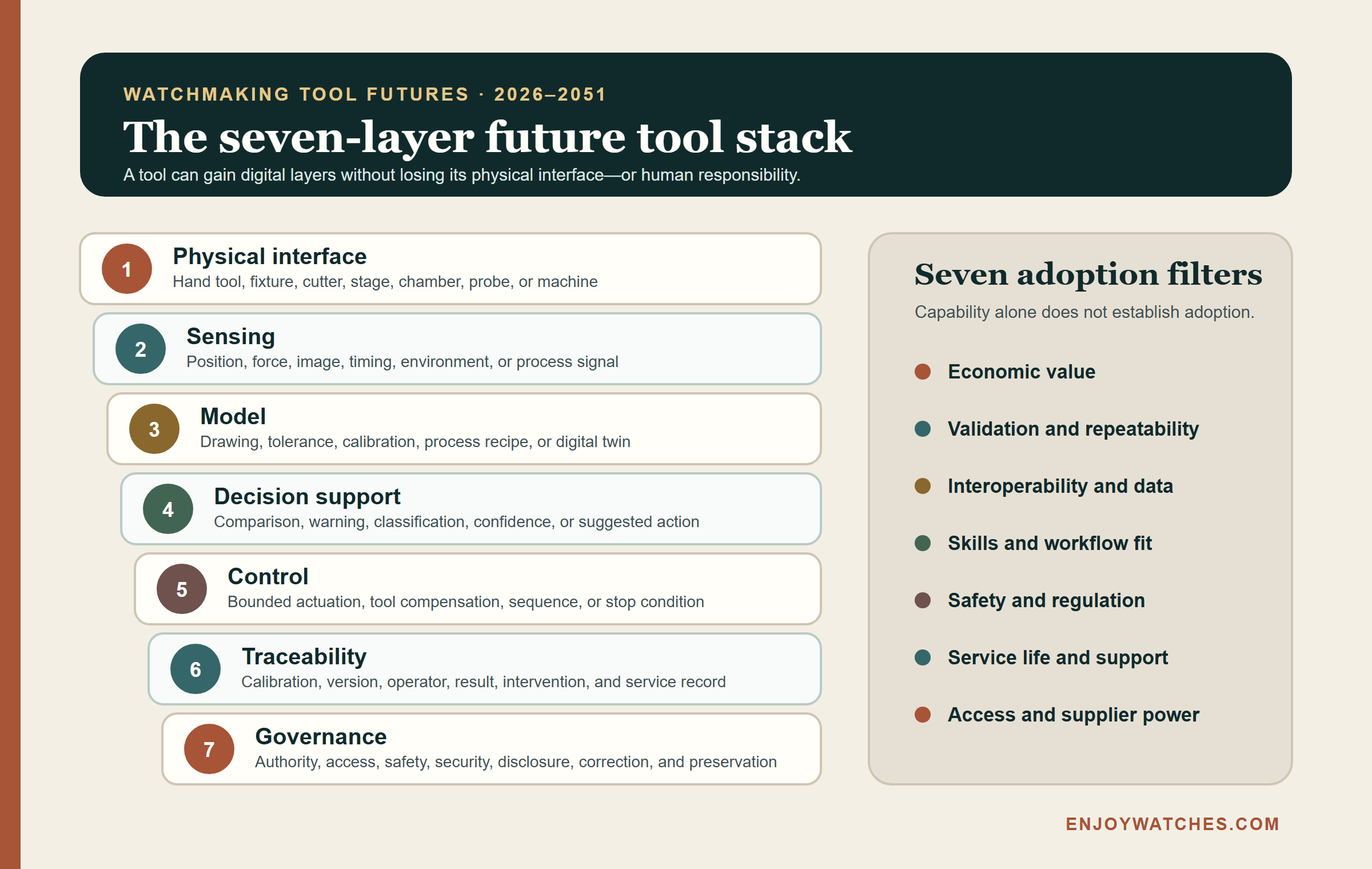
The diagram stacks seven possible layers of a future watchmaking tool: physical interface, sensing, model, decision support, control, traceability, and governance. A side panel lists seven adoption filters: economic value, validation and repeatability, interoperability and data, skills and workflow fit, safety and regulation, service life and support, and access and supplier power.
How to read it
- Begin at the physical interface; every higher layer depends on a tool, workpiece, or process that still exists in the physical world.
- Move upward to see how sensing and models can support decisions, bounded control, records, and accountable use.
- Apply all seven adoption filters before treating technical availability as evidence of practical watch-industry adoption.
What it does not establish
- The stack is an analytical reading aid, not a maturity score, required architecture, implementation plan, or prediction that every tool will gain all seven layers.
- A connected or automated layer does not prove accuracy, safety, interoperability, repairability, authenticity, or superiority over a simpler tool.
Evidence and scope
This original framework synthesizes the companion paper's seven-layer intelligence stack and adoption filters. It is not measured data, an engineering specification, an operating or safety procedure, or evidence that any individual workshop or manufacturer has adopted the full stack.
This visual is a companion to Future of Watchmaking Tools: 2026-2051 Forecast. That guide’s source list was last checked August 24, 2026 and contains the evidence used for its claims.
Reuse: The full visual reuse terms permit unchanged hosted embeds with source attribution, not rehosting, modification, print distribution, bundling, or commercial reuse. Request permission for another use.