
On this page
- The five-minute answer
- Watch diagram: the visible parts
- When you have enough to move on
- No readable reference or brand name?
- What a complete identification looks like
- First, protect the watch and its evidence
- Build a useful photograph set
- Read numbers by function, not by appearance
- Move from broad clues to exact configuration
- Use an evidence matrix instead of intuition
- Grade the identification confidence
- Identification mistakes that create false certainty
- When to stop and obtain specialist help
- Turn an identification into a useful next step
- Final identification checklist
- Further reading
Image disclosure
Type: Generated editorial illustration. Creator: Created for Enjoy Watches using OpenAI image generation.
Prompt-directed synthetic still-life artwork; no real watch, maker, examination, or result is represented. Illustrative only; not evidentiary photography or a source for claims.
About this guide
This guide is published under the organizational byline Enjoy Watches Research Desk. It does not list a named author or independent expert reviewer, and it is not an inspection, appraisal, authentication, or advice for a particular watch. Read the editorial policy before relying on it for a consequential decision.
Publication record
- Risk tier
- Tier 3 — Consequential guidance
- Risk topics
- authentication, physical safety
- Independent review
- Not completed. Internal source checks are not represented as independent expert review.
- Published
- August 24, 2026
- Last substantive update
- October 10, 2026
- Source links checked
- August 24, 2026
- Next source review target
- November 24, 2026
Dates record publication and source-maintenance activity; they do not claim a named expert approval. See the risk-tier policy and corrections log.
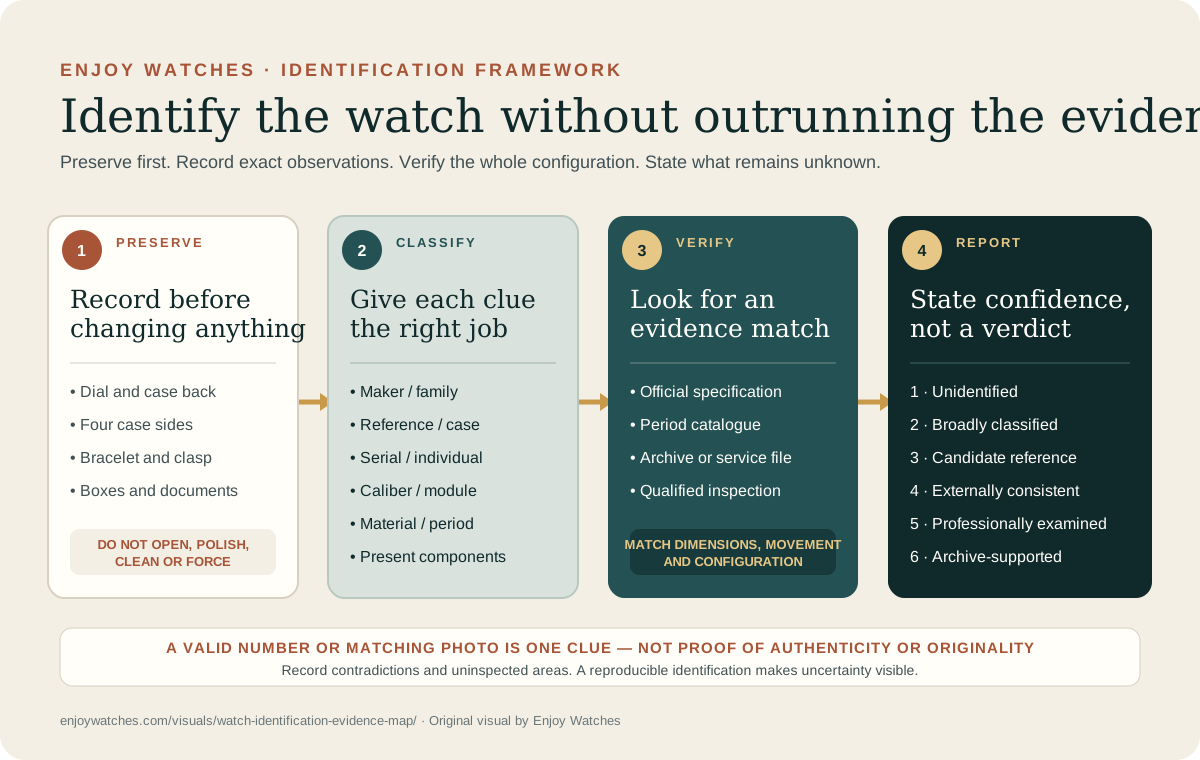
To identify a watch, establish its maker, product family, exact reference or case designation, movement or module, approximate period, material and present configuration. Start with visible evidence and documents, then compare the complete combination with official records. A logo, serial number, reference number or set of photographs can narrow an identity; none proves authenticity by itself.
If the watch may be valuable, vintage, inherited or damaged, do not open it, polish it or operate unfamiliar controls. Identification should preserve evidence, not consume it.
The five-minute answer
Put the watch on a clean, padded surface and record these items before searching:
- every word and symbol on the dial, including small text near six o’clock;
- all visible case-back numbers and marks, keeping their spaces, hyphens and leading zeroes;
- case shape, approximate diameter, metal color, bezel, crown and complications;
- bracelet, clasp and end-link markings without removing parts; and
- numbers, retailer, dates and descriptions on the guarantee, receipt and service records.
Take straight, sharp photographs of the front and back. Search an apparent reference on the manufacturer’s own website or support archive, then compare the watch’s whole specification—not just its face. If a case must be opened or a bracelet removed to continue, stop and use a competent watchmaker or the manufacturer’s authorized service network.
Watch diagram: the visible parts
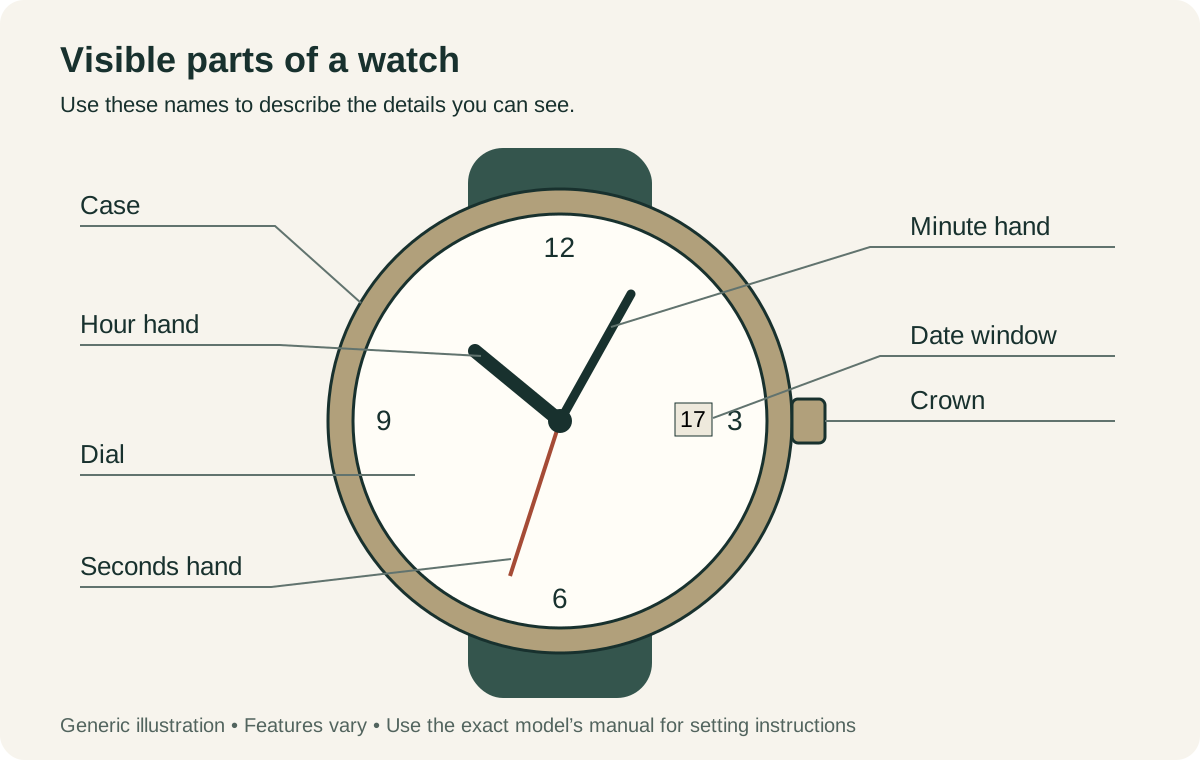
The dial is the face carrying the hour markers. The case surrounds it. This example has hour, minute and seconds hands, a date window and a crown at the right. Use those names when recording details or requesting identification help. Seiko’s 4R34 parts manual provides a manufacturer’s example, including an additional 24-hour hand.
This diagram does not show the internal movement or tell you how to set an unfamiliar watch. Find the manual for the exact movement or model before operating its controls.
When you have enough to move on
Keep a short identification record: the maker or candidate maker, model family or candidate reference, approximate period where supported, the sources you compared, and unresolved or uninspected details. Mark missing information as unknown. You can move on to cautious market research when you have a comparable configuration; a purchase, sale or insurance decision may still require physical examination. A serial number alone does not complete this step.
No readable reference or brand name?
Record the dial lettering, case marks, dimensions, hands, numerals, crown, clasp and paperwork. Preserve exact spellings, punctuation and the location of each mark. Use several compatible clues to narrow the maker and period; leave multiple candidates open when the evidence does not separate them. If the next useful clue is inside the case, ask a competent watchmaker to photograph and document it. Do not open an unfamiliar watch just to obtain another number.
What a complete identification looks like
“Old Omega,” “Rolex Submariner” or “men’s gold watch” is only a starting label. A useful identification has layers:
| Layer | Question answered | Example of responsible wording |
|---|---|---|
| Object type | What category is it? | Mechanical wristwatch with date and chronograph |
| Maker or signature | Whose name appears? | Dial and case signed for Maker X; signature not yet authenticated |
| Family or collection | Which broad design line? | Apparently from the Model Y family |
| Reference or case designation | Which specified model or configuration? | Visible case reference ABC-123, pending confirmation |
| Movement or module | What mechanism and functions should it have? | Caliber 456 recorded on service invoice |
| Period | When was this configuration offered? | Consistent with the maker’s 1998 catalogue |
| Material and size | What was the case specified to be? | Approximately 36 mm; hallmarks require interpretation |
| Present components | What is fitted now? | Later bracelet; dial status not established |
| Individual identifier | Which particular unit may it be? | Serial recorded privately; not published in full |
Keep “appears to be,” “consistent with” and “confirmed by” distinct. That language makes the result more accurate, not less useful. A visible brand name is only one clue: it can identify a manufacturer, retailer, licensee, product family or revival. The watch-brand history guide explains how to test those different claims.
First, protect the watch and its evidence
Do not improve it before identifying it
Do not polish the case, clean the dial, relume the hands or discard an old strap, tag, box or replaced part. Surface geometry, engravings, dial printing and coherent wear can help a specialist assess period and originality. Read the condition and restoration guide before authorizing cosmetic work.
Do not assume a stopped watch needs “a good wind.” A damaged or long-dormant mechanism may need examination first. Avoid repeatedly starting a chronograph, forcing a crown, quick-setting a calendar at random or immersing the watch. A depth rating printed decades ago is not a current pressure test.
Do not open an unfamiliar case
Some identifying numbers are intentionally inside. That does not make owner disassembly sensible. A tool can slip, a gasket can be displaced and dust or moisture can enter. Patek Philippe, for example, says its movement number is on the movement and its case number inside the case back, and directs owners to an authorized retailer or service center for removal (official FAQ). Locations and construction differ by maker and era.
If luminous material is cracked, loose or powdery, do not scrape, brush, blow or vacuum it. Some older clocks and watches used radium paint; the US EPA’s antiques guidance recommends leaving such items intact and seeking appropriate professional advice. Treat an unknown damaged dial as a preservation issue, not a home experiment.
Build a useful photograph set
Use diffuse daylight or a shaded lamp, no digital filters and a neutral background. A phone is sufficient when it focuses clearly.
| View | What to capture | Common failure |
|---|---|---|
| Dial straight-on | All printing, hands, indices and date window | Angled reflection hides the text |
| Case back straight-on | Entire engraving layout and hallmarks | Cropping off an apparently minor number |
| Four case sides | Crown, pushers, case profile and lug shape | Showing only the “best” side |
| Bracelet and clasp | Construction, stamps, link count and damage | Treating bracelet marks as the watch reference |
| Documents, separately | Front and back, edges, numbers and stamps | Posting personal details or full serial publicly |
| Group record | Watch with its accessories as received | Mixing boxes and papers from several watches |
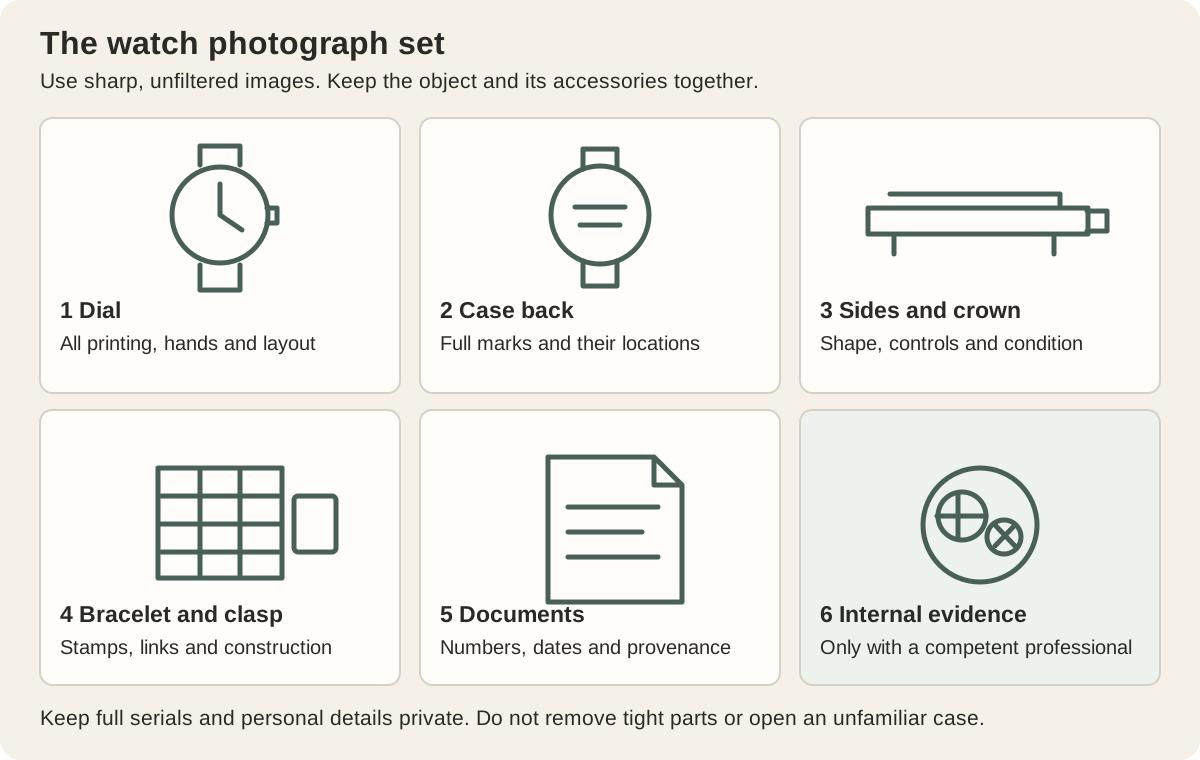
Do not remove a tight bracelet merely to obtain a photograph. If a professional opens the case, ask for sharp images before anything is cleaned: the complete movement, movement number, inner case back, gaskets and any watchmaker marks.
Read numbers by function, not by appearance
The same-looking code can serve different purposes. Record its location as carefully as its characters.
- A reference, model or case number usually identifies a product specification or family.
- A serial or case serial usually distinguishes an individual unit within a maker’s system.
- A caliber, movement or module number identifies the mechanism or an operating-instruction family.
- A bracelet, clasp, end-link, dial or part number identifies a component, not necessarily the watch.
- A limited-edition number, such as 37/100, states a position in an edition; it need not be the manufacturer’s service serial.
There is no cross-brand grammar. Seiko directs owners to a caliber code on the case back to find instructions (Seiko). Citizen says the first four characters in certain case-number formats identify the movement (Citizen). Grand Seiko’s warranty system distinguishes reference, model and serial fields and says the model and serial are inscribed on the back (Grand Seiko). These official examples are reasons to consult the correct maker and period rather than a universal serial decoder.
Use the watch reference-number guide to transcribe and research codes without collapsing these categories.
Move from broad clues to exact configuration
1. Start with what the dial claims
Transcribe the brand, collection name, retailer co-signature, country or origin wording, chronometer wording and any technology label. Note the layout: number of hands and subdials, date position, scale type, numeral style and luminous plots.
The dial is an excellent search clue but a poor single source of identity. Dials are replaceable, refinished and imitated. A genuine dial can also be fitted to the wrong case or movement.
2. Match the external case
Record shape, diameter excluding the crown, lug-to-lug length, thickness, bezel type, crown guards, pushers and case-back construction. Do not round a measurement so aggressively that a 34 mm and 36 mm model become the same.
Compare these observations with an official product page, catalogue or manual. Check the complete specification: material, dimensions, movement, complications, water-resistance wording, bracelet and dial options. One matching dimension does not overcome three contradictions.
3. Interpret metal marks cautiously
A metal-color description is not a metal test. Photograph hallmarks and assay marks exactly. A mark may identify fineness, an assay office, a sponsor or maker, an import regime or a date convention; these systems depend on jurisdiction and period. The British Hallmarking Council’s official guidance explains, for the UK system, the separate roles of sponsor, fineness and assay-office marks.
A hallmark can support the case-material identification. It does not authenticate the dial, movement or entire watch, and an external stamp deserves physical examination if a consequential decision depends on it.
4. Check the expected movement without opening the watch yourself
Official specifications may state the expected caliber. Documents, a transparent back or professional photographs can show what is present. Compare architecture and markings as well as the caliber label. A correct caliber family may have multiple executions, and a genuine movement can be transplanted.
Record the examiner’s name, date and whether the conclusion came from direct inspection, a service document or a photograph. “Movement not inspected” is a valid and important result.
5. Place the configuration in time
Design families evolve. Compare the watch with sources from the proposed production period, not only today’s product page. Useful dated evidence includes manufacturer catalogues, manuals, price lists, advertisements, service records and archive services.
Some makers can connect an individual number with historical records. Longines says its archives preserve information associated with timepiece serial numbers and offers both archive extracts and a separate, examination-based authenticity certificate (Longines). Patek Philippe likewise distinguishes its original Certificate of Origin from a later Extract that transcribes archival information (Patek Philippe). Read the scope: an archive record is not automatically a certificate for every component now fitted.
Use an evidence matrix instead of intuition
Create one row per claim. This original worksheet prevents a plausible story from outrunning the object.
| Claim to test | Direct object evidence | Documentary or official comparison | Result | Remaining uncertainty |
|---|---|---|---|---|
| Maker | Dial and case signatures | Maker records or specialist inspection | Unknown / consistent / confirmed | Signatures not yet authenticated |
| Exact reference | Visible code and case dimensions | Period catalogue specification | ||
| Movement | Professional movement photograph | Caliber technical record | ||
| Production period | Serial format and design details | Dated archive or catalogue | ||
| Case material | Hallmarks and testing | Assay-system reference | ||
| Dial configuration | Printing, layout and lume | Period options and known transitions | ||
| Bracelet | Clasp and end-link marks | Period parts information | ||
| Original-to-watch | Component coherence | Service and ownership records | Usually difficult to prove |
Contradictions are productive. A reference associated with a time-only watch but a dial with a date, or an expected manual movement but an automatic rotor, tells you what needs expert resolution.
Grade the identification confidence
Use a ladder rather than a binary answer:
- Unidentified: insufficient legible evidence.
- Broadly classified: maker or family appears likely.
- Candidate reference: one or more references fit visible evidence.
- Externally consistent: dimensions and accessible components agree with a primary specification.
- Professionally examined: internal identifiers and construction have been inspected and documented.
- Archive-supported: maker records connect stated identifiers with historical information, within the document’s scope.
Even the highest level does not mean “every part original” unless that separate claim is established. Read authenticity versus originality before using either word in a listing.
Identification mistakes that create false certainty
| Shortcut | Why it fails | Better practice |
|---|---|---|
| Image-searching the dial | Similar faces cross references and counterfeiters copy visible designs | Match numbers, construction, movement and dated specifications |
| Finding a valid serial range | A number can be copied, altered or attached to an inconsistent object | Treat it as one evidence layer |
| Matching an online listing | Listings repeat errors and may disappear | Prefer official or dated primary material |
| Assuming box and papers settle identity | Sets can be mixed, altered or forged | Cross-check every number and configuration |
| Calling every internal number a serial | It may be a caliber, case or part number | Record location and maker terminology |
| Dating from one design feature | Parts can be changed and transitions overlap | Use several independent dated clues |
| Opening the case for “proof” | Damage may cost more than the information gained | Use a qualified professional |
When to stop and obtain specialist help
Escalate before selling, insuring, servicing or buying when the likely value is meaningful, identifiers conflict, the watch has a precious-metal or gem-set case, the dial may contain unstable old luminous material, provenance is important, or access requires disassembly.
Ask the examiner to provide:
- the exact claim they were asked to assess;
- external and internal photographs;
- every identifier and its location;
- the reference materials used;
- component-by-component observations;
- known service or replacement parts;
- tests performed and limitations; and
- a conclusion with confidence, not merely “looks good.”
Authentication expertise is often reference-specific. A general repair technician may be excellent mechanically without being the right historian for a rare dial variation.
Turn an identification into a useful next step
Once identity is sufficiently supported, preserve the evidence file and choose the next question:
- For market research, use what is my watch worth? and compare completed sales of the same reference and configuration.
- For a purchase, use the pre-owned watch questions to test the seller’s evidence and return terms.
- For an inheritance, keep the family account and ownership documents with the watch using the inherited-watch workflow.
- Before polishing, replacing parts, reluming or servicing, check condition, originality and previous restoration. Preserve the current configuration and agree the purpose of any work first.
- For insurance, estate or another formal purpose, choose an appraiser for that purpose. A market estimate is not a formal appraisal.
- For a sale, plan a safe sale and disclose uncertainty and replacements rather than converting an owner-level identification into an absolute guarantee.
Final identification checklist
- I photographed the watch and accessories before cleaning or service.
- I copied every visible code with its exact location and punctuation.
- I separated reference, serial, caliber/module and component numbers.
- I kept the full serial out of public images.
- I compared material, dimensions, movement and complications—not only the dial.
- I used manufacturer or period primary sources where available.
- I recorded contradictions and uninspected areas.
- I did not open the case or remove difficult parts myself.
- I described identification confidence separately from authenticity and originality.
- I obtained a qualified physical examination before a high-stakes decision.
The goal is not to produce the fastest model name. It is to create a reproducible identification that another careful reader can audit without damaging the watch or exaggerating what the evidence proves.
Further reading
Sources and assumptions
Links checked August 24, 2026. Time-sensitive claims are scheduled for review by November 24, 2026.
- Seiko official instruction finderRole: Commercial first-party policy. Scope: Supports the maker's own published technical service identifier or restoration guidance; not independent authentication or advice for a particular watch.
- Citizen official manuals and case-number guideRole: Commercial first-party policy. Scope: Supports the maker's own published technical service identifier or restoration guidance; not independent authentication or advice for a particular watch.
- Grand Seiko electronic warranty identifier guideRole: Commercial first-party policy. Scope: Supports the maker's own published programme or warranty terms at the source-check date; eligibility scope and rights must be checked for the actual market and transaction.
- Patek Philippe watch-authenticity FAQRole: Commercial first-party policy. Scope: Supports the maker's own published technical service identifier or restoration guidance; not independent authentication or advice for a particular watch.
- Patek Philippe Extract from the Archives FAQRole: Commercial first-party policy. Scope: Supports the maker's own archive-service definition eligibility and limits; not present-condition evidence or independent authentication of a watch.
- Longines History of My Watch serviceRole: Commercial first-party record. Scope: Supports the maker or corporate museum's own published historical record or claim; commercial provenance is visible and independent corroboration may still be required.
- UK British Hallmarking Council guidanceRole: Government or intergovernmental source. Scope: Supports the named UK guidance and its stated hallmarking scope; not a rule for another jurisdiction or proof about a particular watch.
- US EPA: Radioactivity in AntiquesRole: Government or intergovernmental source. Scope: Supports general US agency safety guidance about radioactive antiques; not an object-specific diagnosis test or disposal instruction.
- Seiko 4R34 — Names of the parts and their functionsRole: Commercial first-party policy. Scope: Supports the names of hands, date display and crown in Seiko’s 4R34 manual; the original generic illustration is not a setting guide for a particular model.
Send the claim and its source to [email protected]. Material corrections are logged. The contact page records the current mailbox-delivery limitation; retain your report until receipt is acknowledged.