Original visual guide
Five Dates in Watch-Brand History
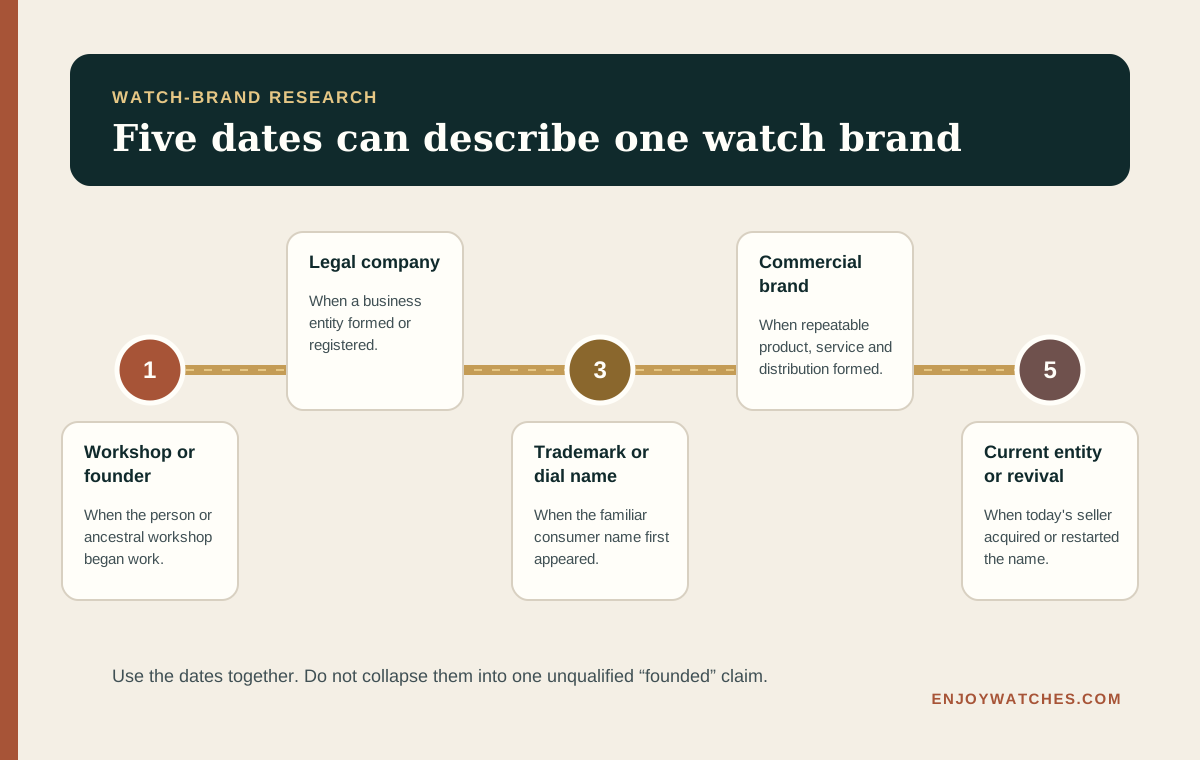
A practical diagram that separates a watch brand's workshop, legal company, trademark, commercial formation and current-entity or revival dates.
Published by Enjoy Watches · Updated August 24, 2026
Visual disclosure
Type: Original explanatory diagram. Creator: Enjoy Watches Research Desk.
Method: Source-led editorial synthesis. Labels, layout, and spatial relationships are illustrative reading aids, not a measured dataset or an inspection of a particular watch.
Evidence boundary: This original explanatory diagram summarizes the companion guide's research framework. It is not a legal, trademark, corporate-register or authentication conclusion about a specific brand or watch.
Cite this visual
A stable citation and asset record
Use the canonical visual page when citing or linking. The public media-kit manifest lists this visual's dated formats and canonical address.
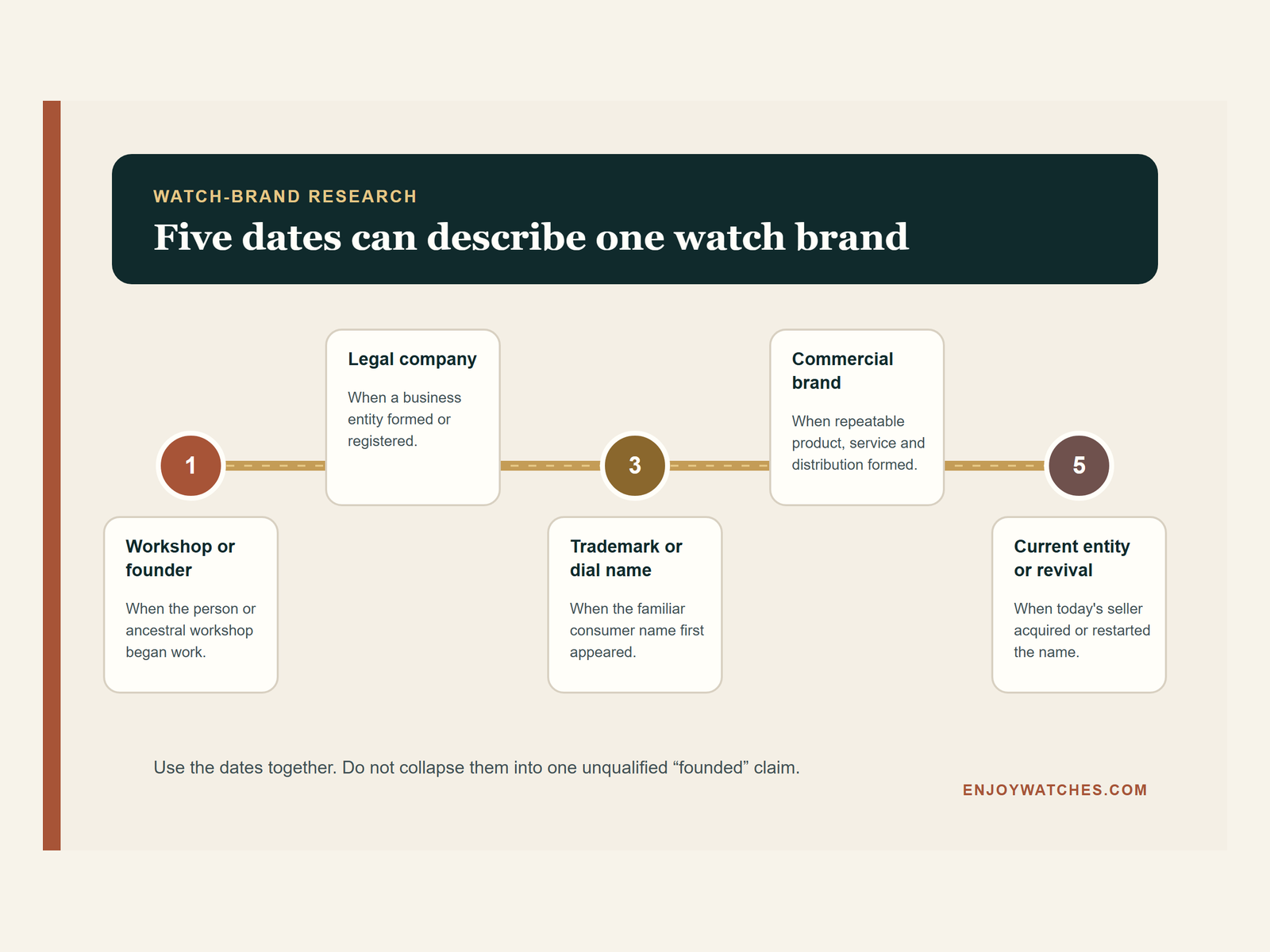
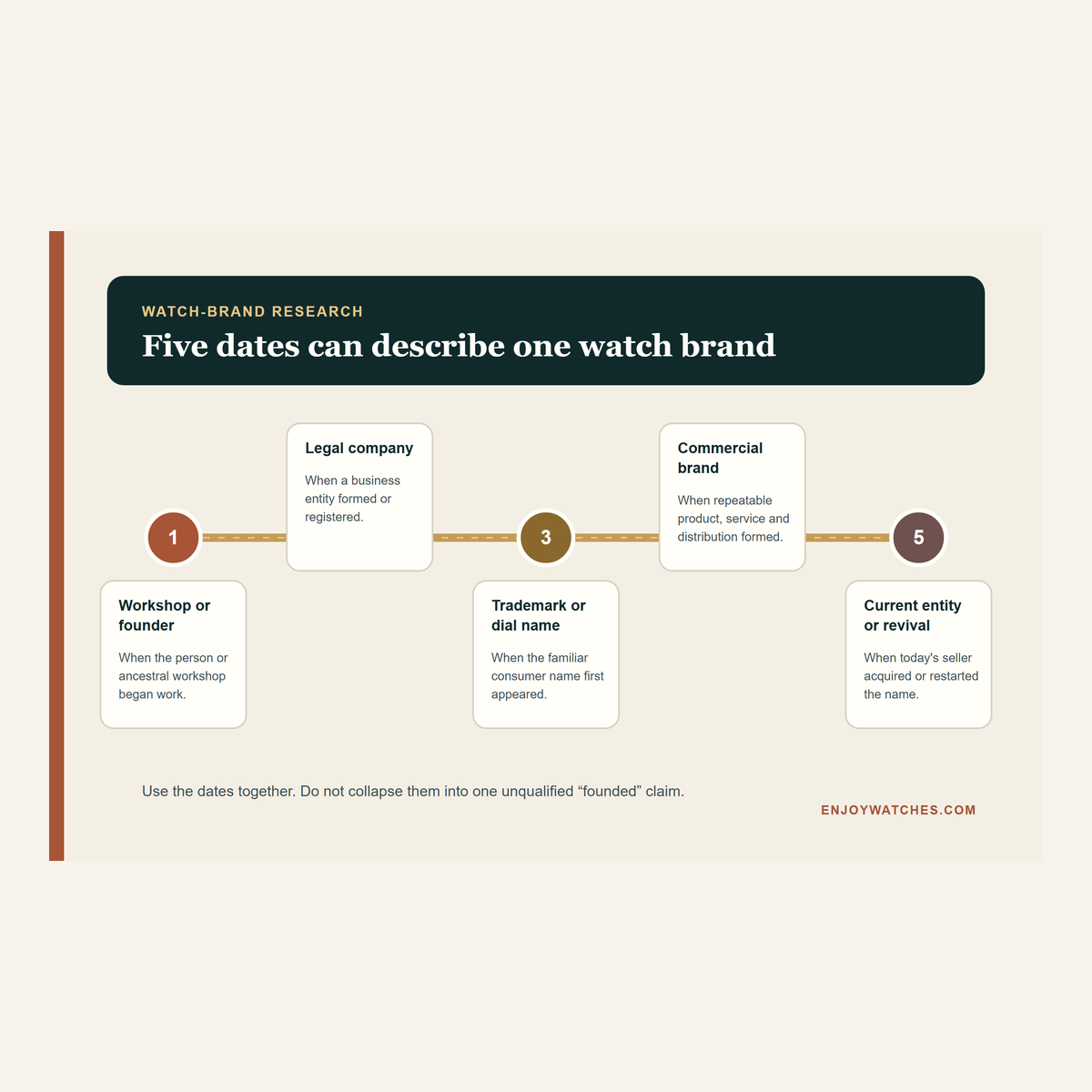
Use the date that answers the question
A founder's workshop, a legal company, a consumer mark, a stable commercial brand and a current revival may all have different dates. Record the entity, source, date checked and any known interruption beside the claim. Corporate heritage pages can be useful primary evidence of a company's stated history, but consequential claims should be checked against suitable independent or official records too.
Reuse and attribution
© 2026 Enjoy Watches. You may link to this page or embed the hosted visual with its source intact. A hosted embed makes a normal image request to this site; the supplied code uses referrerpolicy="no-referrer" to avoid sending the embedding page's address. For republication, modification, print, or other reuse, request permission.
Text version of the diagram
A five-step horizontal timeline separates five dates that can describe one watch brand: the founder or workshop, legal company, trademark or dial name, commercial brand formation, and current entity or revival. The final instruction is to use the dates together rather than collapse them into one unqualified founded claim.
How to read it
- Choose the historical claim you need to test before selecting a date.
- Record each applicable date with its source and the entity it describes.
- State interruptions, ownership changes, product-family separations and revivals rather than hiding them.
What it does not establish
- The earliest date does not automatically prove continuous operation by the current company.
- A later revival is not necessarily illegitimate, but it must be described as a revival rather than uninterrupted production.
Evidence and scope
This original explanatory diagram summarizes the companion guide's research framework. It is not a legal, trademark, corporate-register or authentication conclusion about a specific brand or watch.
This visual is a companion to History of Watch Brands: A Global Encyclopedia. That guide’s source list was last checked August 24, 2026 and contains the evidence used for its claims.
Reuse: The full visual reuse terms permit unchanged hosted embeds with source attribution, not rehosting, modification, print distribution, bundling, or commercial reuse. Request permission for another use.