Original visual guide
Watch Identification Evidence Map
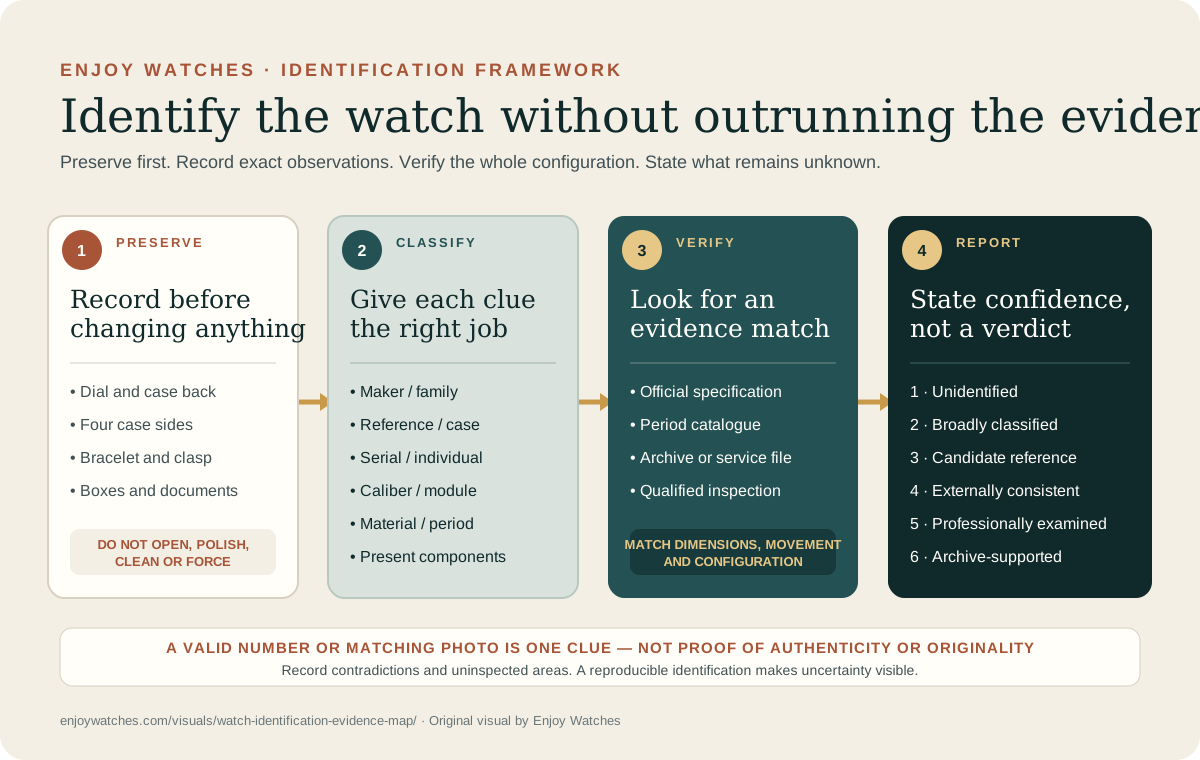
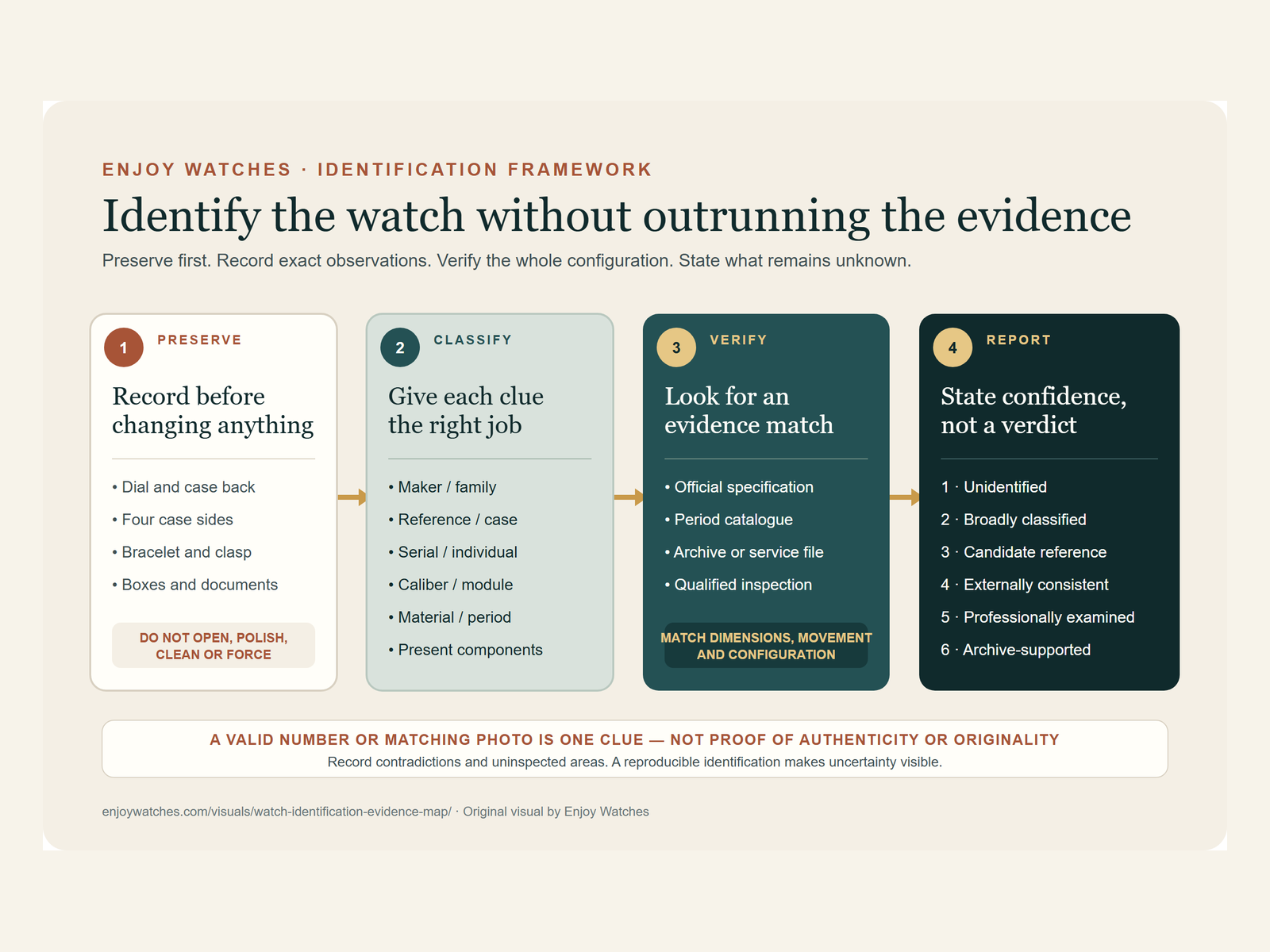
A safe route from recording an unknown watch to a qualified identification, with separate stages for preservation, classification, verification, and confidence.
Published by Enjoy Watches · Updated August 24, 2026
Visual disclosure
Type: Original explanatory diagram. Creator: Enjoy Watches Research Desk.
Method: Source-led editorial synthesis. Labels, layout, and spatial relationships are illustrative reading aids, not a measured dataset or an inspection of a particular watch.
Evidence boundary: This original explanatory diagram summarizes the safe identification workflow in the companion guide. It is not a remote authentication service or a substitute for inspection.
Cite this visual
A stable citation and asset record
Use the canonical visual page when citing or linking. The public media-kit manifest lists this visual's dated formats and canonical address.
Use the map as an evidence boundary
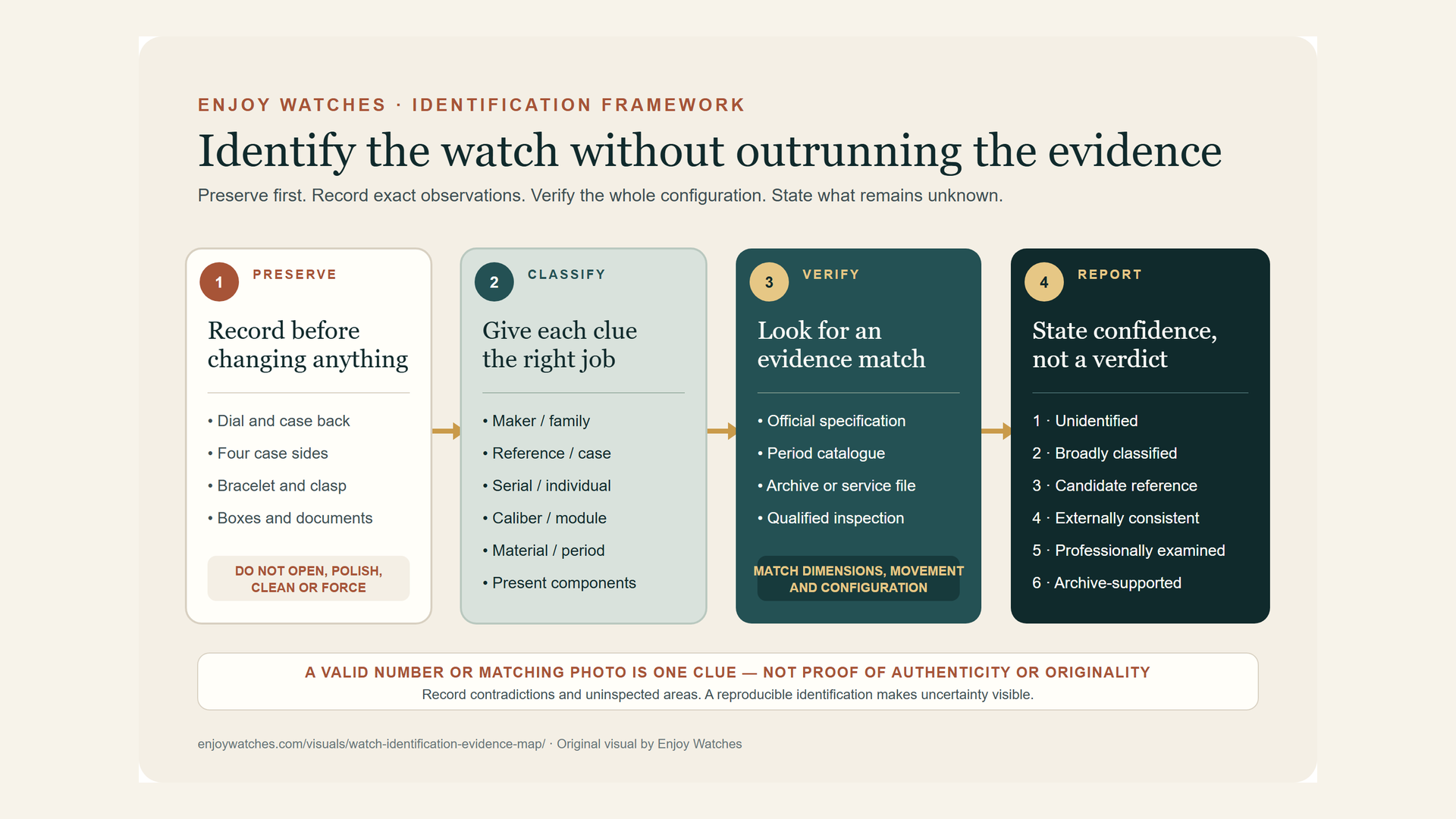
Begin with non-invasive observations, separate model, unit, movement, material, period, and component claims, then look for agreement across official specifications, period records, archives, and qualified inspection. A serial or photographic match can support a conclusion, but it cannot prove authenticity or originality by itself.
Reuse and attribution
© 2026 Enjoy Watches. You may link to this page or embed the hosted visual with its source intact. A hosted embed makes a normal image request to this site; the supplied code uses referrerpolicy="no-referrer" to avoid sending the embedding page's address. For republication, modification, print, or other reuse, request permission.
Text version of the diagram
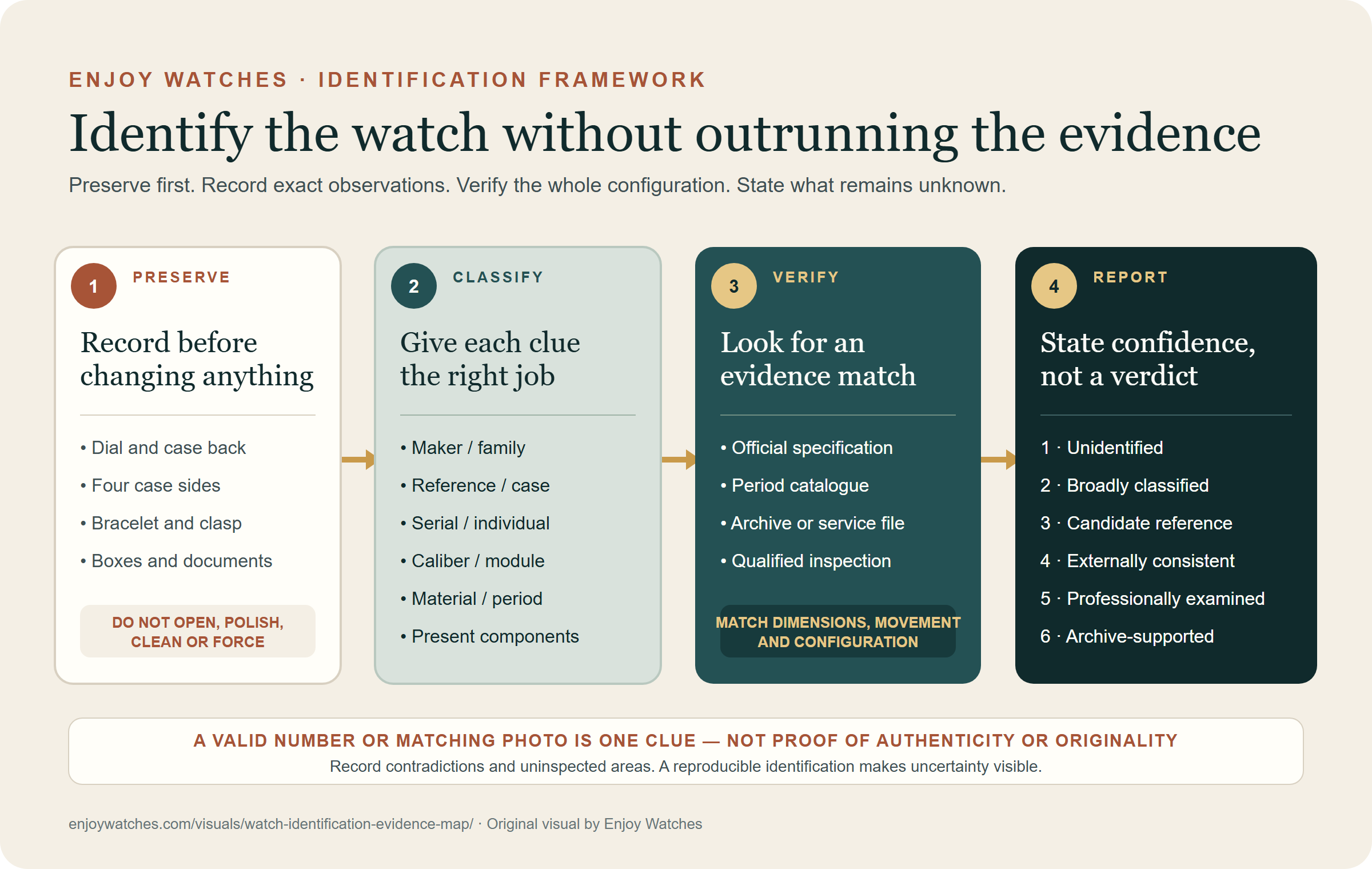
Four stages move from preserving and photographing an unknown watch, through classifying its clues, to verification against suitable evidence and a confidence statement that retains contradictions and uninspected areas.
How to read it
- Preserve the object and record what is visible without opening or altering it.
- Classify maker, model, number, component, and period clues before searching.
- Verify the whole configuration and state a bounded confidence result rather than a definitive label.
What it does not establish
- An image match or a number match alone is not full identification or authentication.
- The map does not authorize opening, cleaning, or testing a watch that needs professional handling.
Evidence and scope
This original explanatory diagram summarizes the safe identification workflow in the companion guide. It is not a remote authentication service or a substitute for inspection.
This visual is a companion to How to Identify a Watch: Maker, Model and Reference. That guide’s source list was last checked August 24, 2026 and contains the evidence used for its claims.
Reuse: The full visual reuse terms permit unchanged hosted embeds with source attribution, not rehosting, modification, print distribution, bundling, or commercial reuse. Request permission for another use.