Original visual guide
Five Regimes of Watchmaking Precision
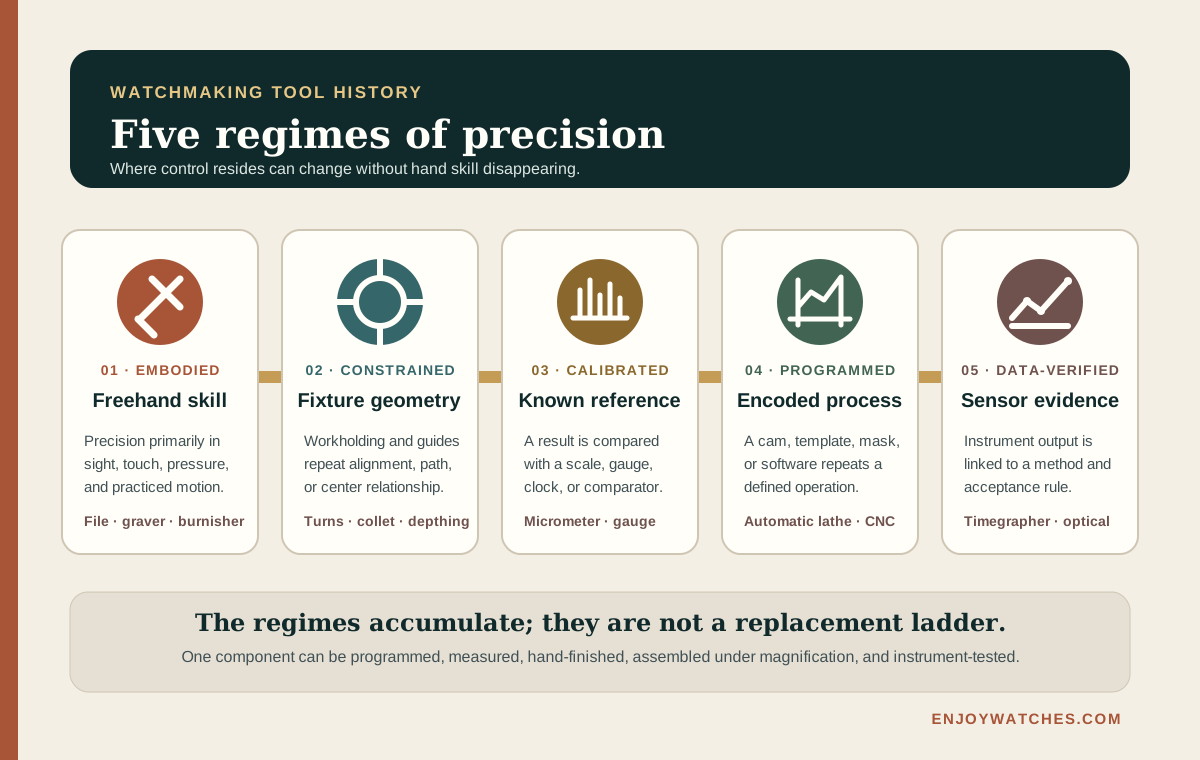
A five-part visual showing precision held in hand skill, constrained fixtures, calibrated references, programmed processes, and sensor-backed verification.
Published by Enjoy Watches · Updated August 24, 2026
Visual disclosure
Type: Original explanatory diagram. Creator: Enjoy Watches Research Desk.
Method: Source-led editorial synthesis. Labels, layout, and spatial relationships are illustrative reading aids, not a measured dataset or an inspection of a particular watch.
Evidence boundary: This diagram is an analytical reading aid, not an operating instruction, safety procedure, process specification, measured dataset, or assessment of a particular workshop or watch.
Cite this visual
A stable citation and asset record
Use the canonical visual page when citing or linking. The public media-kit manifest lists this visual's dated formats and canonical address.
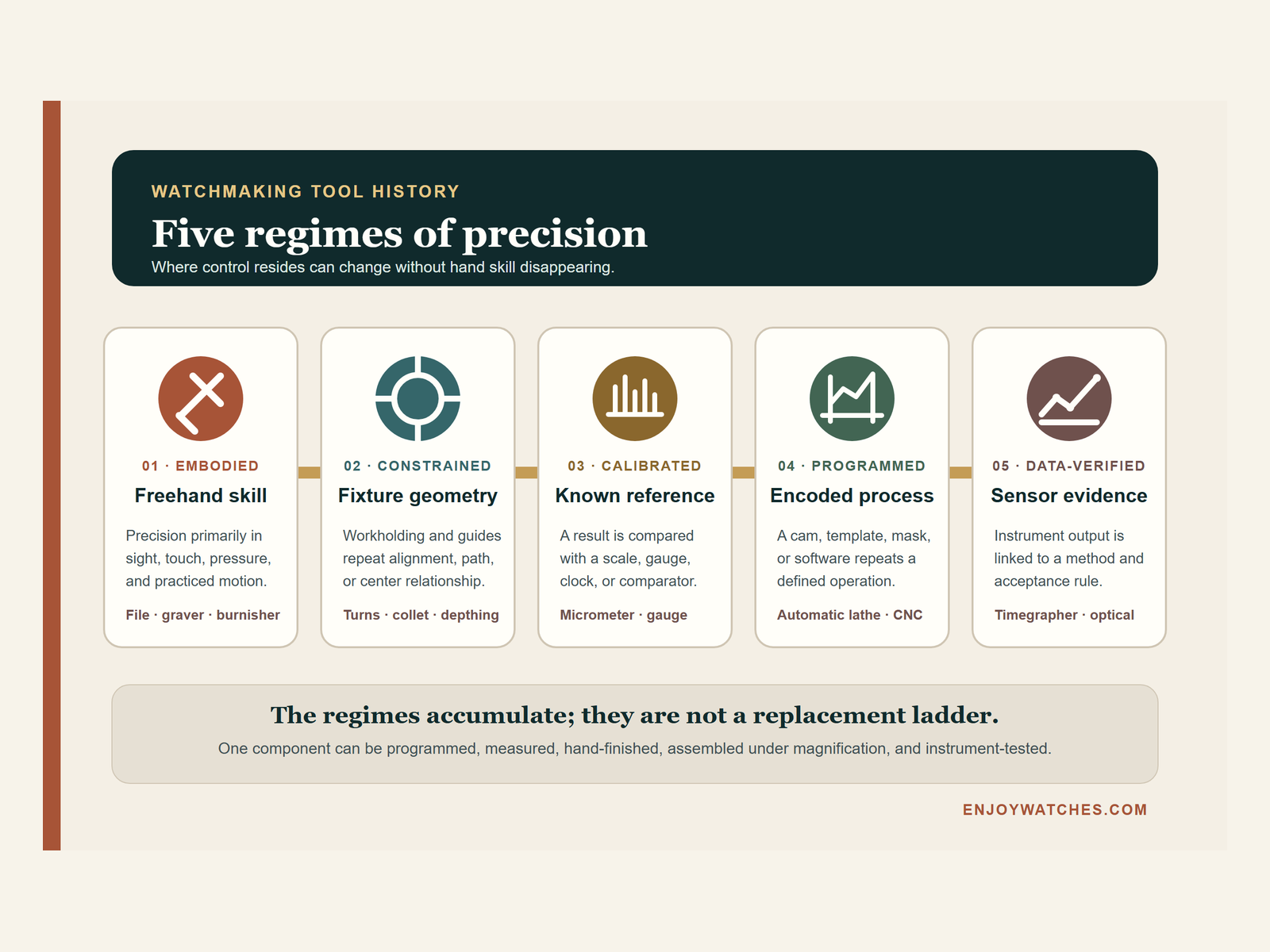
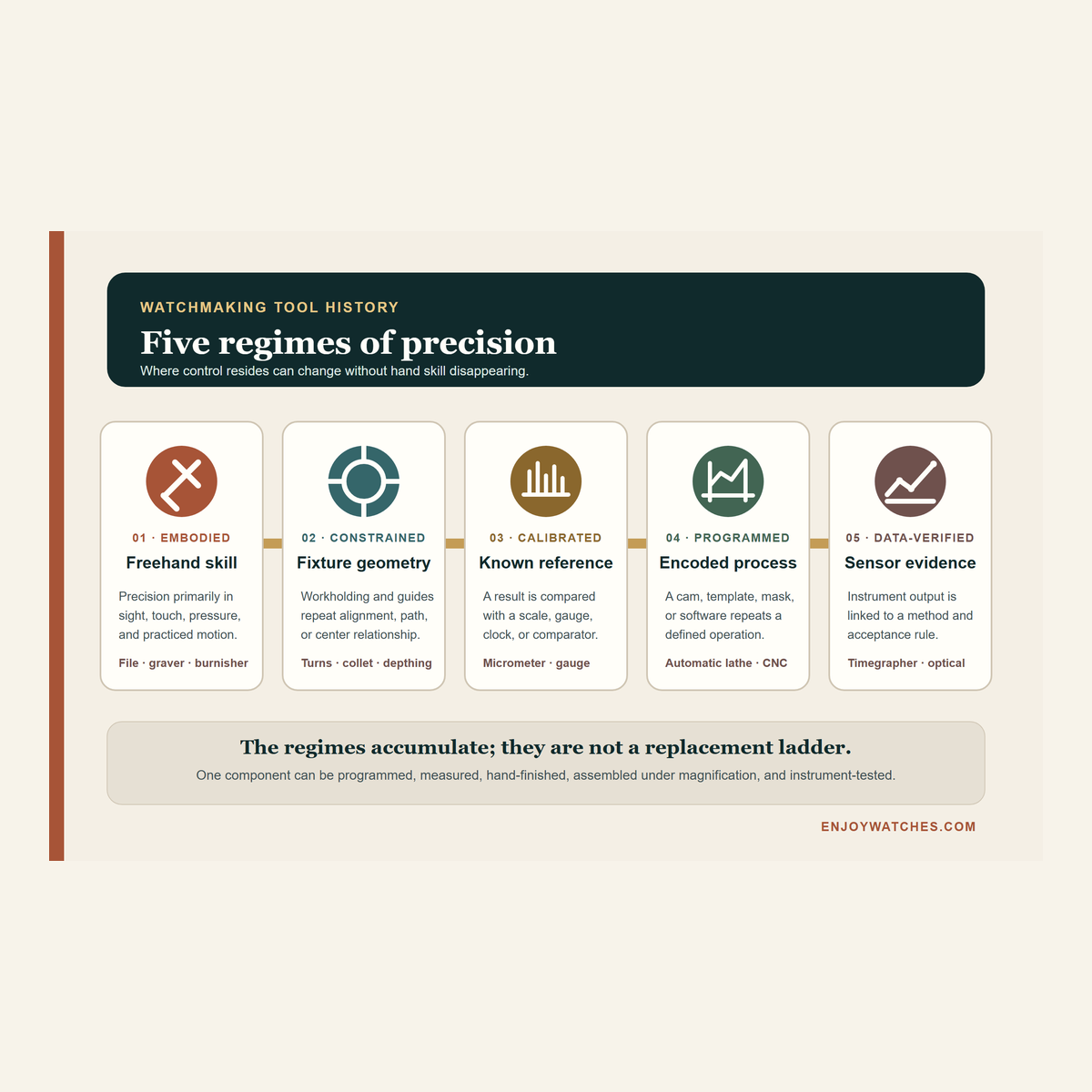
Precision moves through a chain
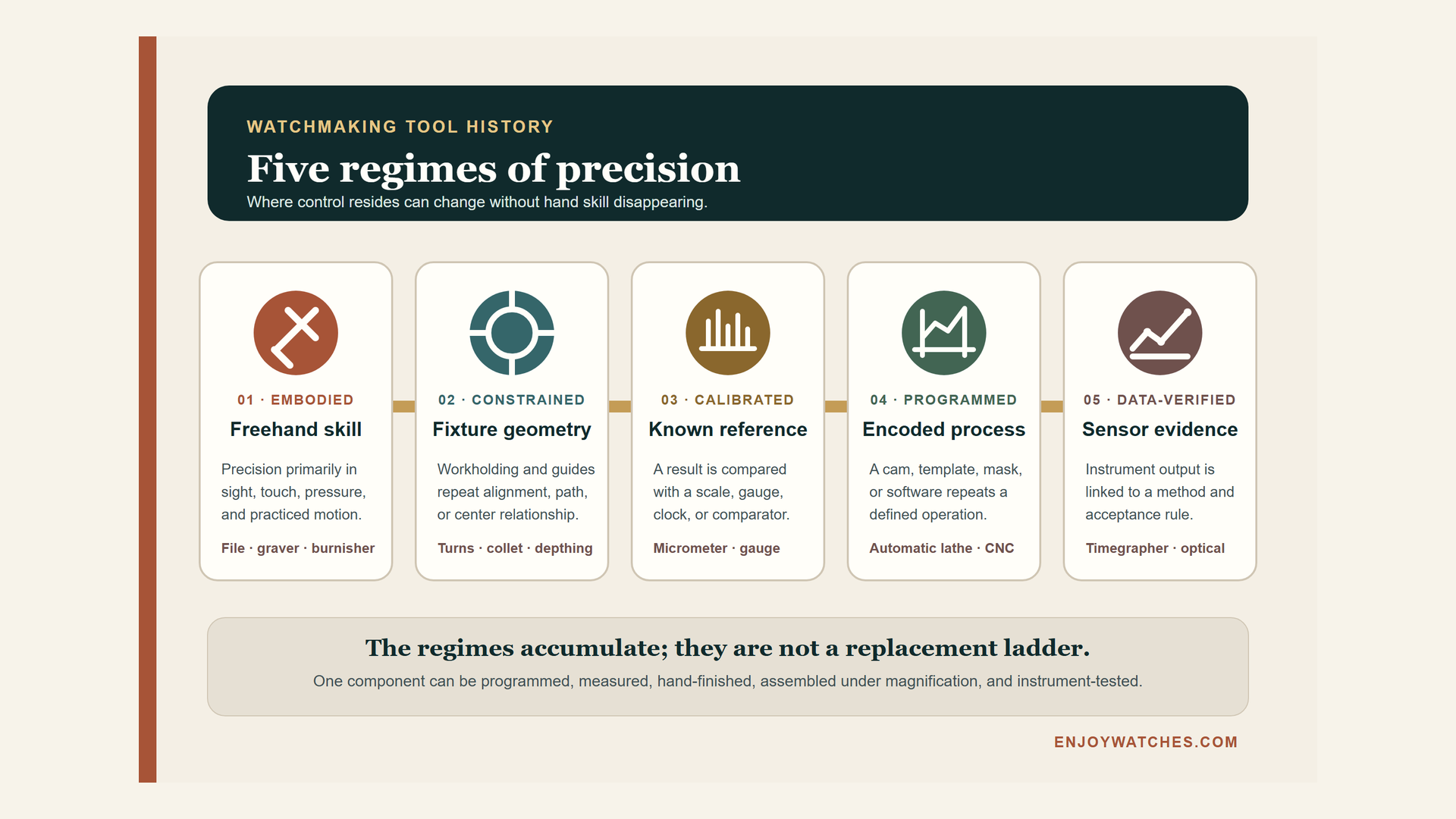
A pivot can be shaped by hand, held between centers, compared with a reference, produced to an encoded drawing, and checked optically. Each layer removes one uncertainty while introducing assumptions about setup, calibration, process control, or interpretation.
How the dataset labels differ
The companion dataset preserves more granular supplied precision_regime labels for retrieval. This five-part visual groups the larger concept for reading; it does not silently recode the 326 public records.
Reuse and attribution
© 2026 Enjoy Watches. You may link to this page or embed the hosted visual with its source intact. A hosted embed makes a normal image request to this site; the supplied code uses referrerpolicy="no-referrer" to avoid sending the embedding page's address. For republication, modification, print, or other reuse, request permission.
Text version of the diagram
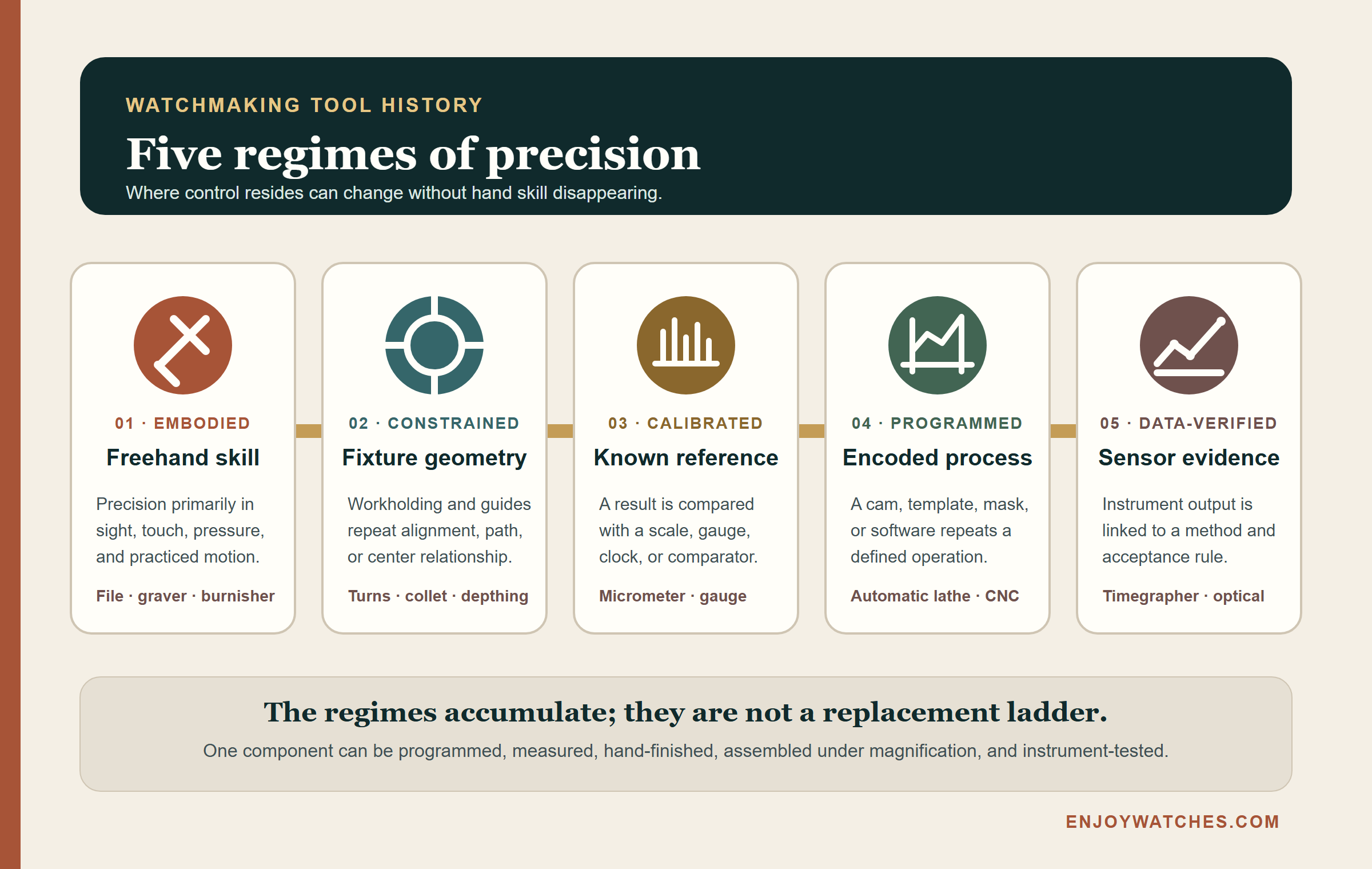
Five connected cards describe where precision can reside. Embodied or freehand control depends mainly on practiced sight, touch, pressure, and motion. Constrained control uses workholding and fixtures to repeat alignment or geometry. Calibrated control compares a result with a known scale or reference. Programmed control encodes an operation in a cam, template, mask, or software. Data-verified control links sensor output to a method and acceptance rule. The closing note explains that these regimes accumulate rather than form a replacement ladder.
How to read it
- Start by identifying where the decisive control resides for the operation being described.
- Follow a component across several regimes instead of assigning a whole watch to only one category.
- Keep the method, reference, setup, worker judgment, and acceptance rule visible when interpreting a measured result.
What it does not establish
- The five regimes are an editorial classification, not a universal chronology, performance score, or measured dataset.
- Programmed or sensor-backed work does not eliminate hand skill, and traditional handwork does not by itself prove quality, age, originality, or safety.
Evidence and scope
This diagram is an analytical reading aid, not an operating instruction, safety procedure, process specification, measured dataset, or assessment of a particular workshop or watch.
This visual is a companion to History of Watchmaking Tools: Hand Files to Silicon. That guide’s source list was last checked August 24, 2026 and contains the evidence used for its claims.
Reuse: The full visual reuse terms permit unchanged hosted embeds with source attribution, not rehosting, modification, print distribution, bundling, or commercial reuse. Request permission for another use.