Original visual guide
Four Watch Number Types
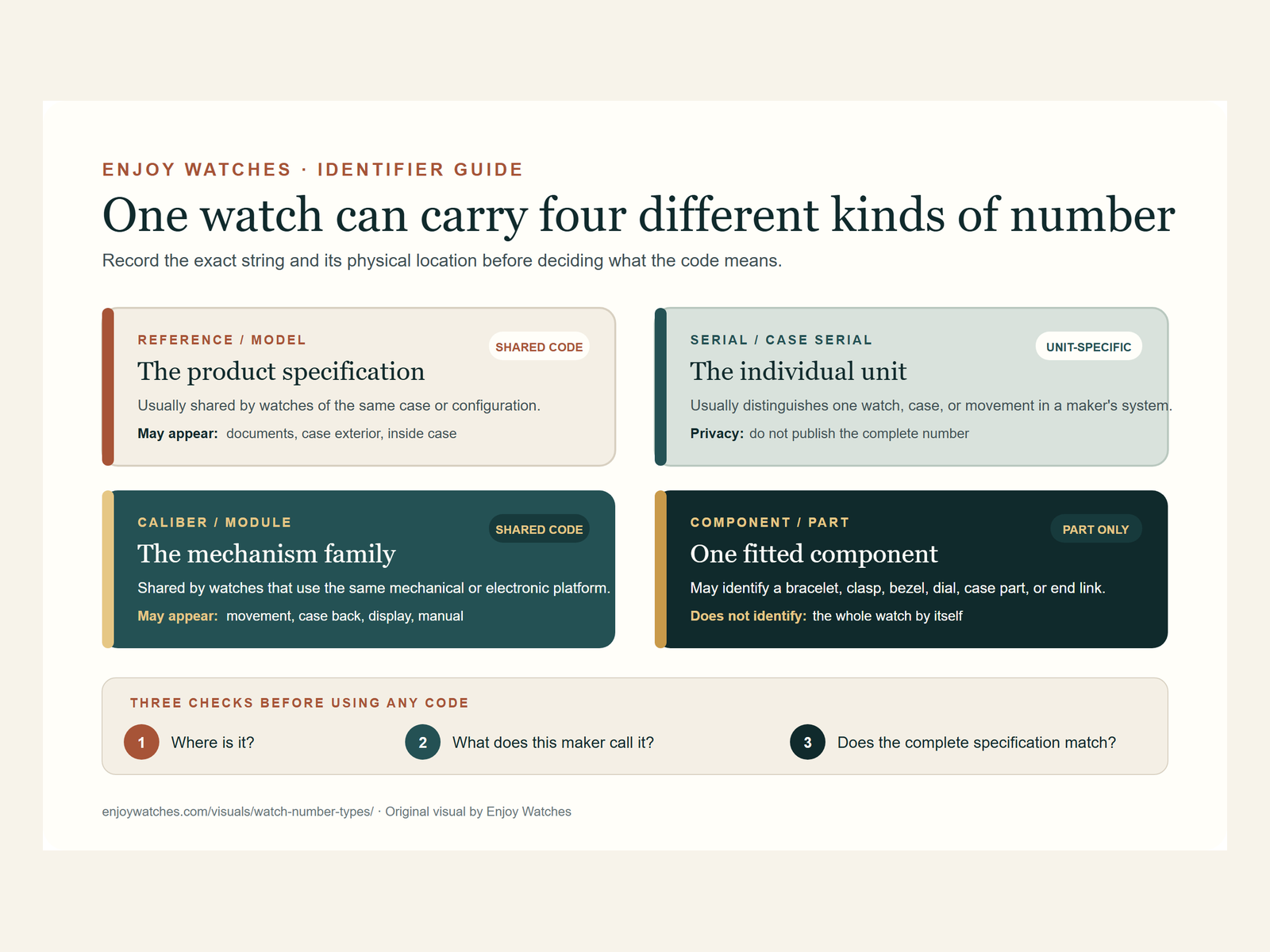
Reference, serial, caliber or module, and component numbers answer different questions. This field guide shows what each usually identifies and what it cannot establish alone.
Published by Enjoy Watches · Updated August 24, 2026
Visual disclosure
Type: Original explanatory diagram. Creator: Enjoy Watches Research Desk.
Method: Source-led editorial synthesis. Labels, layout, and spatial relationships are illustrative reading aids, not a measured dataset or an inspection of a particular watch.
Evidence boundary: This original explanatory field guide organizes number types explained in the companion guide. It is not a serial-number database or an authentication result.
Cite this visual
A stable citation and asset record
Use the canonical visual page when citing or linking. The public media-kit manifest lists this visual's dated formats and canonical address.
Location is part of the identifier
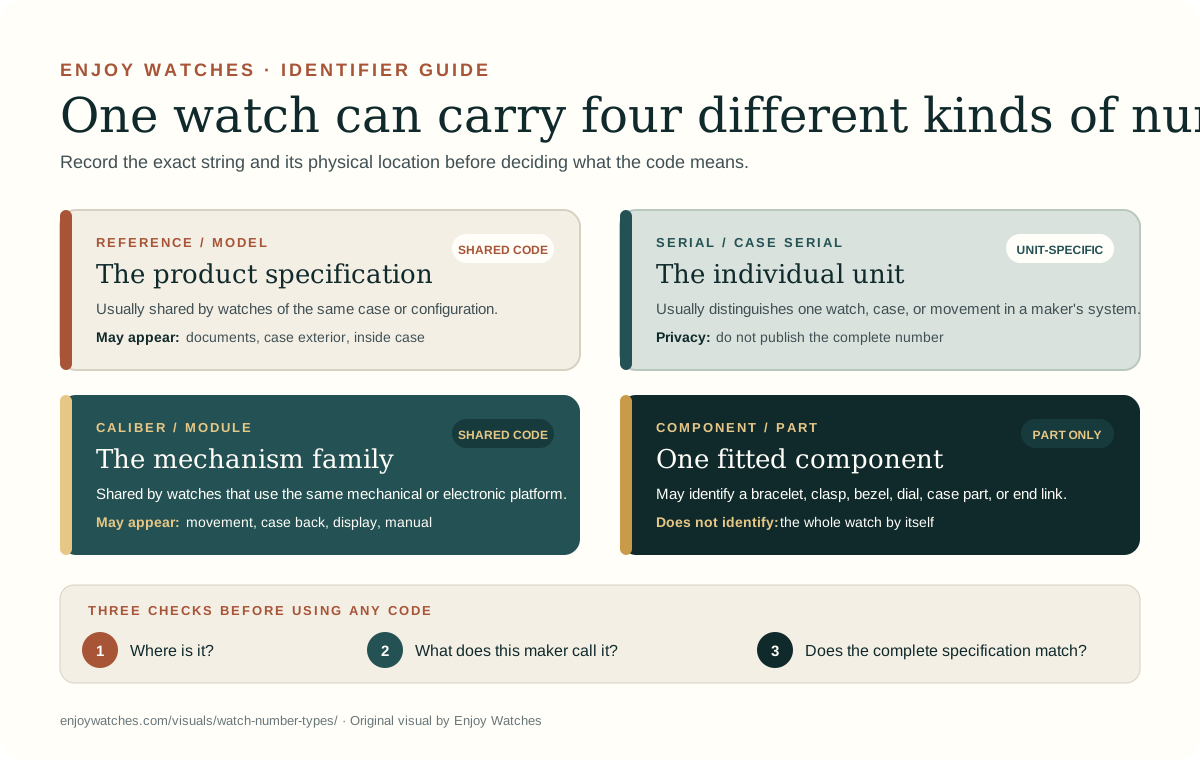
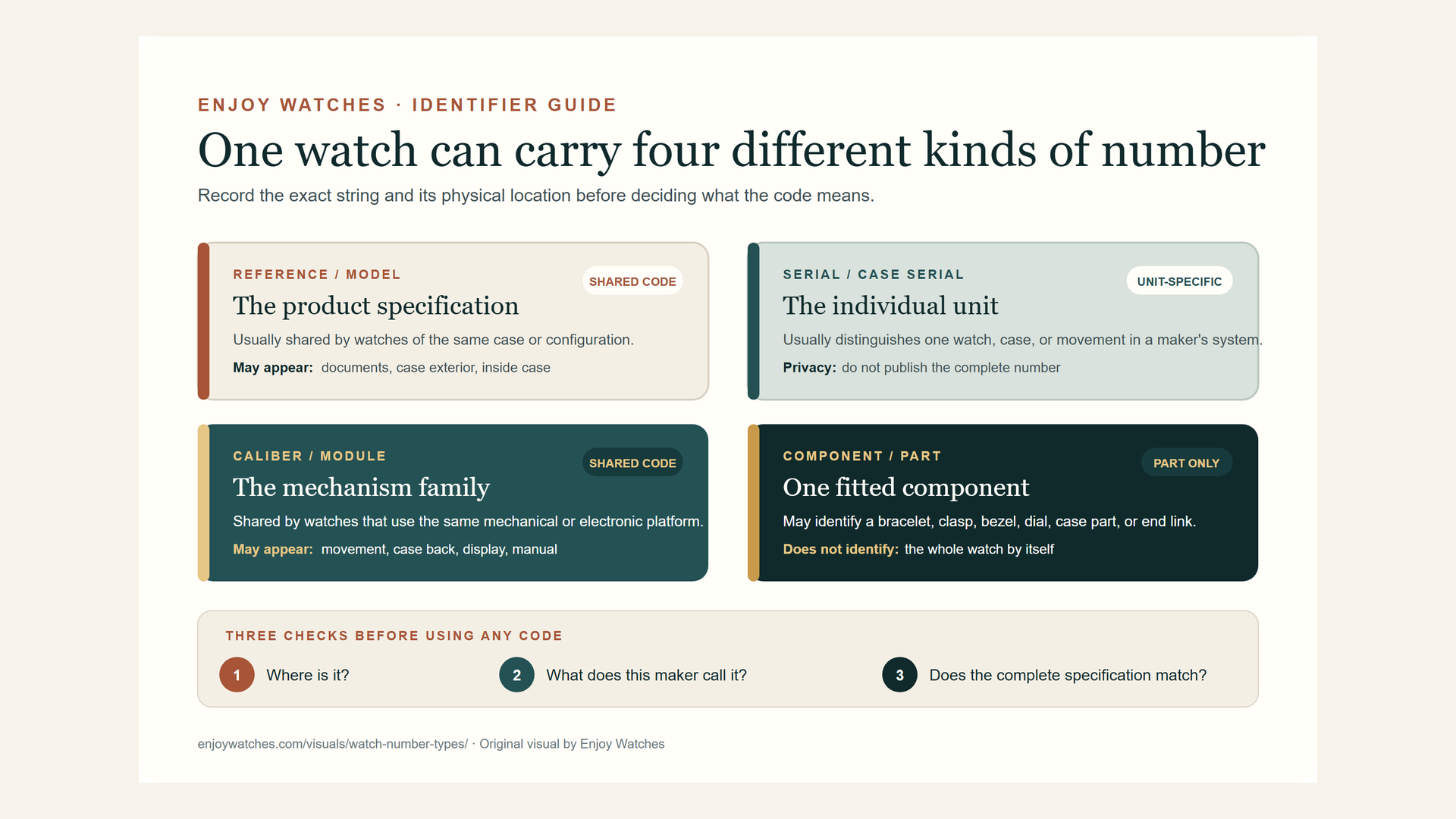
The same-looking string can describe a model, one unit, a movement family, or a replaceable part. Record punctuation and leading zeroes, protect complete serials from public disclosure, and never use a bracelet or clasp code as the identity of the whole watch without corroboration.
Reuse and attribution
© 2026 Enjoy Watches. You may link to this page or embed the hosted visual with its source intact. A hosted embed makes a normal image request to this site; the supplied code uses referrerpolicy="no-referrer" to avoid sending the embedding page's address. For republication, modification, print, or other reuse, request permission.
Text version of the diagram
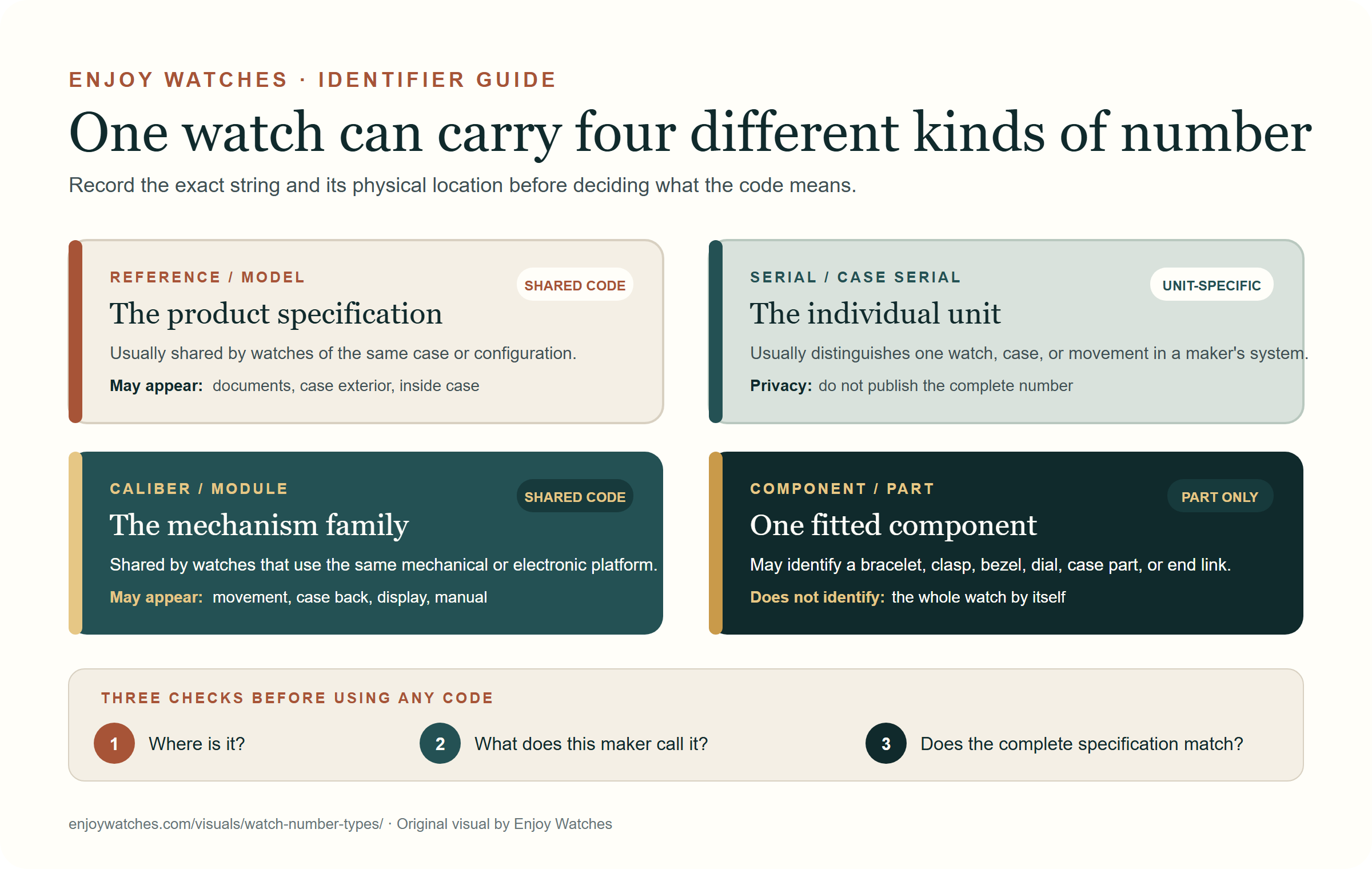
Four cards distinguish reference or model numbers, serial or case serials, calibre or module numbers, and component or part numbers. A final check asks the reader to record location, maker terminology, and whether the full specification agrees.
How to read it
- Copy the exact string, punctuation, and location before looking it up.
- Decide which kind of number it is according to the maker’s terminology.
- Verify that the number fits the complete case, movement, dial, bracelet, and documented configuration.
What it does not establish
- A serial, bracelet, or clasp code is not automatically the identity of the whole watch.
- A number lookup does not prove authenticity, originality, ownership, or value.
Evidence and scope
This original explanatory field guide organizes number types explained in the companion guide. It is not a serial-number database or an authentication result.
This visual is a companion to Watch Reference Numbers: Find, Read and Verify the Right Model. That guide’s source list was last checked August 24, 2026 and contains the evidence used for its claims.
Reuse: The full visual reuse terms permit unchanged hosted embeds with source attribution, not rehosting, modification, print distribution, bundling, or commercial reuse. Request permission for another use.