

On this page
- Reference, serial, caliber and model: the quick table
- Why the exact reference matters
- Where to look without damaging the watch
- How identifier systems differ in official practice
- A reproducible reference-number workflow
- Step 1: Preserve the string exactly
- Step 2: Label the physical location
- Step 3: Separate visible codes before searching
- Step 4: Search the maker’s official ecosystem
- Step 5: Match the complete published specification
- Step 6: Cross-check documents against the object
- Step 7: Distinguish “matches a reference” from “is authentic”
- Step 8: Escalate contradictions
- How to handle suffixes, separators and variant codes
- Vintage and discontinued references
- Privacy and stolen-number risk
- Using a reference to research value
- A seller’s reference disclosure template
- Reference-number checklist
Image disclosure
Type: Generated editorial illustration. Creator: Created for Enjoy Watches using OpenAI image generation.
Prompt-directed synthetic still-life artwork; no real watch, maker, measurement, or outcome is represented. Illustrative only; not evidentiary photography or a source for claims.
About this guide
This guide is published under the organizational byline Enjoy Watches Research Desk. It does not list a named author or independent expert reviewer, and it is not an inspection, appraisal, authentication, or advice for a particular watch. Read the editorial policy before relying on it for a consequential decision.
Publication record
- Risk tier
- Tier 3 — Consequential guidance
- Risk topics
- identification, authentication
- Independent review
- Not completed. Internal source checks are not represented as independent expert review.
- Published
- August 24, 2026
- Last substantive update
- No later substantive update is recorded.
- Source links checked
- August 24, 2026
- Next source review target
- November 24, 2026
Dates record publication and source-maintenance activity; they do not claim a named expert approval. See the risk-tier policy and corrections log.
A watch reference number normally identifies a model, case design or defined configuration; a serial number normally identifies one individual watch. A caliber or module identifies the movement or electronic mechanism, while a collection name can cover many references. Copy every code exactly, record where it appears, and verify it against the maker’s own specification before using it to research value or authenticity.
There is no universal reference-number decoder. Brands—and sometimes different eras within one brand—structure and locate identifiers differently. A valid-looking reference or serial is evidence, not proof that the watch or every fitted component is genuine.
Reference, serial, caliber and model: the quick table
| Identifier | Usually describes | Usually shared by | What it does not prove |
|---|---|---|---|
| Reference number | Model, case or commercial configuration | Many watches of the same specified type | That this individual watch is genuine or unchanged |
| Serial number | An individual watch, case or movement in a maker’s system | Usually one recorded unit, though practices vary | Authenticity merely because the format is plausible |
| Caliber or movement number | Movement design or family | Many watches using that mechanism | The external reference or that the movement began in this case |
| Module number | Electronic operating platform and instructions | Multiple digital or connected models | Exact case, color or strap variant |
| Case number | Case design, production code or sometimes an individual case | Meaning depends on maker | A universal category across brands |
| Limited-edition number | Stated position within an edition, such as 37/500 | One position in the stated run | The service serial, production order or authenticity |
| SKU or variant code | A sellable combination for a market or retailer | Units sold in that configuration | A permanent historical reference system |
| Part number | Bracelet, clasp, dial, bezel or other component | Compatible components | The identity of the whole watch |
Use the maker’s vocabulary. If an official form has separate fields for “reference,” “model” and “serial,” do not merge them because a marketplace calls all three a model number.
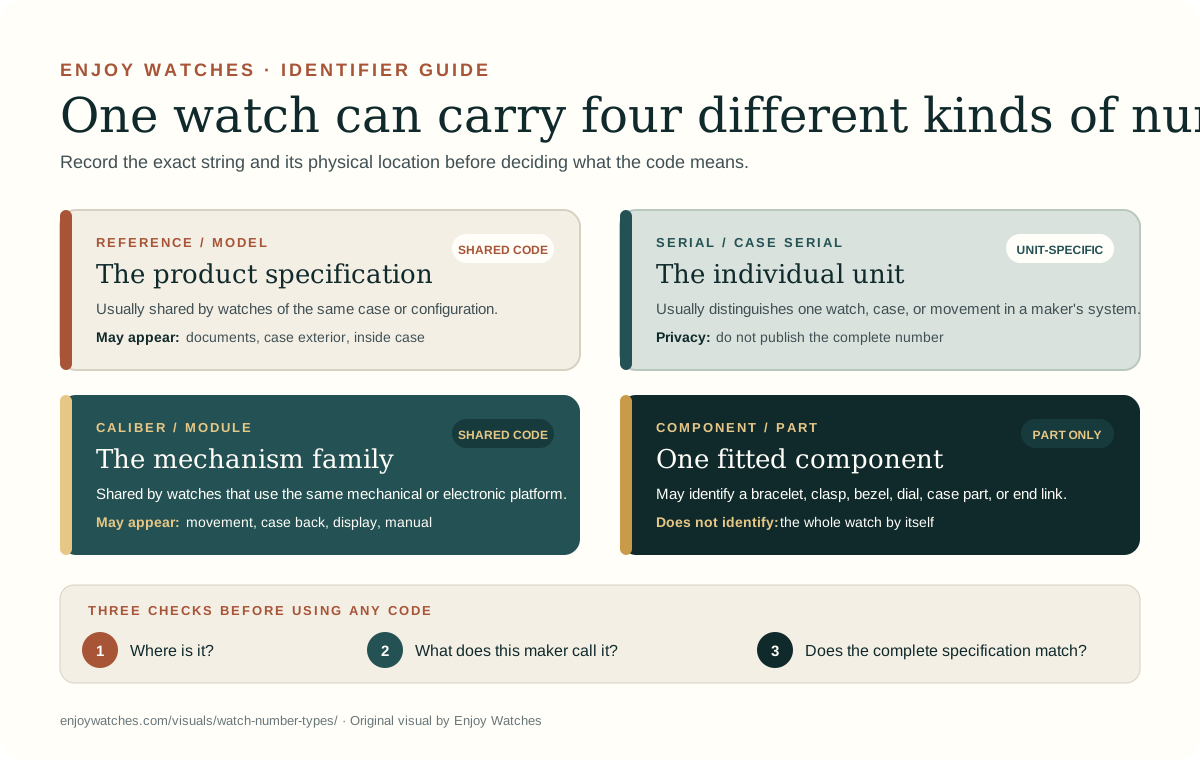
Why the exact reference matters
One model name can hide differences in size, material, movement, dial, bezel, bracelet and production period. Those differences affect compatibility, collectibility, service options and price.
Consider a familiar current example. Rolex’s official Submariner page identifies the watch as reference 124060, specifies a 41 mm Oystersteel case and caliber 3230, and uses m124060-0001 in the page address (Rolex). The page itself is the authority for the displayed reference; the longer URL string should not be treated as a universal Rolex-decoding rule.
For valuation, comparing “Submariners” is too broad. Even comparing reference 124060 is incomplete if one price includes a full bracelet, guarantee, tax, dealer warranty and excellent condition while another does not. First establish the reference, then use the comparable-sales guide to normalize the remaining differences.
Where to look without damaging the watch
Search in this order:
- original guarantee, warranty record, receipt or service invoice;
- visible case back and case sides;
- dial, rehaut or display menus where the maker uses them;
- clasp and bracelet, recording these explicitly as component marks;
- manufacturer account or registered electronic warranty; and
- internal case and movement only during qualified professional inspection.
Use a loupe or a phone’s macro mode over a padded table. Photograph the entire engraving layout before zooming into one code. Never scrape dirt from an engraving, force off a bracelet or improvise a case-opening tool.
Some numbers are hidden by design. Patek Philippe states that its movement number is engraved on the movement and its case number inside the case back; it says removal should be performed by an authorized retailer or service center (Patek Philippe). The correct lesson is not “all references are inside.” It is that locations are brand- and construction-specific, and professional access may be required.
How identifier systems differ in official practice
The following examples are not a decoder for every watch from each maker. They demonstrate the differences an owner must respect.
| Maker and official example | What the maker calls the number | Practical use | Caution |
|---|---|---|---|
| Rolex current product page | Reference 124060; caliber 3230 | Match the published current model specification | Do not infer every historic rule from a current URL or reference |
| Seiko support | Caliber code on the case back | Find the applicable instruction manual | A caliber code is not necessarily the retail reference |
| Citizen support | Case number in stated hyphenated formats; first four characters are the movement number | Select an operating manual | Engraving position varies, and the rest is not simply a serial decoder |
| Grand Seiko warranty | Separate reference, model and serial fields | Register or retrieve warranty details | Limited-edition numerator and serial are handled under stated rules |
| Grand Seiko instructions | Four-digit caliber within a case-number example such as 9R01-0AA0 | Identify the movement family and instructions | The whole case number contains more than the caliber |
| Casio support | Module number and model-name search | Find an operation guide | One module can support more than one outward model |
| Patek Philippe records | Reference, movement and case numbers | Identify a timepiece in original or archival records | Important identifiers may be internal; archive scope is limited |
Seiko explicitly tells owners to check the case back for a caliber code when selecting instructions (Seiko). Citizen documents case-number patterns such as four characters, a hyphen and six or seven more characters, with the first four representing the movement number (Citizen). Grand Seiko’s instruction material describes the four-character caliber portion within a case number (Grand Seiko instructions), while its warranty tool separates reference, model and serial (warranty guide).
Casio’s support system permits search by module number or model name (Casio). That is useful for finding the correct controls; it does not mean the module alone specifies every case and colorway. Official terminology resolves ambiguity better than third-party charts. Use the watch-brand history guide alongside this process when a familiar dial name may be a retailer signature, product family, license or revival rather than the whole maker identity.
A reproducible reference-number workflow
Step 1: Preserve the string exactly
Copy uppercase and lowercase letters, spaces, periods, slashes, hyphens and leading zeroes. Distinguish 0 from O, 1 from I, 5 from S and 8 from B. Take one image of the whole location and one close-up.
Write:
AB12-0345, exterior case back, lower arc, photographed 24 August 2026
Do not write only:
model AB120345
The first note preserves evidence; the second silently decides the code’s function and removes potentially meaningful punctuation.
Step 2: Label the physical location
“On the watch” is not enough. Record exterior case back, inner case back, between lugs, rehaut, movement bridge, dial edge, clasp, end link, hang tag or document. A bracelet code found beside the watch’s serial can otherwise be mistaken for the reference.
Step 3: Separate visible codes before searching
Create a simple inventory:
| Code as observed | Location | Apparent type | Confirmed by maker? | Public or private? |
|---|---|---|---|---|
| Unknown | No | |||
| Possible reference | No | |||
| Possible serial | No | Keep private | ||
| Bracelet or clasp | No |
Do not force an interpretation merely because a search engine returns a result.
Step 4: Search the maker’s official ecosystem
Try the exact code in quotation marks and pair it with the maker:
site:maker.example "AB12-0345"site:maker.example AB12 manualsite:maker.example AB12 archive
Use the real manufacturer domain, its regional support site, downloadable catalogues and authorized archive or service pages. Save a PDF or screenshot with its title, URL and access date when it will support an important listing or valuation.
Search results and marketplace snippets are leads. They are not primary specifications.
Step 5: Match the complete published specification
Check more than the title:
- case material, diameter and profile;
- dial color and index layout;
- bezel type and scale;
- movement or module and stated functions;
- crown and pusher arrangement;
- bracelet or strap option;
- display type, date position and complications; and
- production or catalogue period.
A code that returns the right-looking dial but the wrong case material needs investigation. It may be misread, a component number, a variant omitted by the source, a replacement case or an assembled watch.
Step 6: Cross-check documents against the object
Compare reference and serial on the guarantee, receipt, service invoice and archive record with the visible or professionally recorded watch identifiers. Check dates, retailer, material and dial wording too.
Documents can be mixed with another watch. Conversely, a genuine watch may have lost its original papers. Treat agreement as one layer of evidence and disagreement as a reason to stop.
Step 7: Distinguish “matches a reference” from “is authentic”
Responsible conclusion:
The visible case code and measurements are consistent with reference X’s published specification; movement and component originality have not been examined.
Overclaim:
The serial comes back correct, so it is 100% authentic.
Numbers can be copied, altered, repeated in fraudulent listings or transplanted with components. A correct reference only tells you which specification to test. Read how authentication differs from originality.
Step 8: Escalate contradictions
Use a maker-authorized service center, reference specialist or suitably experienced watchmaker when internal access is necessary, the value is consequential or the configuration conflicts with official records. Ask for photographs and exact observations rather than a one-word verdict.
How to handle suffixes, separators and variant codes
Suffixes can indicate a dial, material, bracelet, market, packaging or revision—or be a retailer’s inventory extension. Their meaning is not stable across brands.
Follow three rules:
- Never discard the suffix during transcription. It may be the only distinction between configurations.
- Never decode it by analogy with another maker. Similar letters can have unrelated meanings.
- Name the source of the interpretation. “Manufacturer product page labels this configuration…” is stronger than “forums say the last two letters mean…”
When an official page presents both a short reference and a longer URL or order code, store both in separate fields. Do not silently choose one as “the real number.”
Vintage and discontinued references
Current website search is weakest for old watches. Build a dated source ladder:
- original guarantee, invoice and service papers;
- manufacturer archive or heritage department;
- period manufacturer catalogue, manual or price list;
- respected auction catalogue with detailed physical examination;
- specialist reference scholarship with disclosed evidence; and
- marketplace listings only as leads.
An archive extract and an authenticity certificate are not synonyms. Patek Philippe says its Extract from the Archives is a partial transcript of historical records, while its original Certificate of Origin includes movement, case and reference numbers (Patek Philippe). Read each maker’s eligibility, evidence requirements and exclusions.
Production estimates built from public serial tables can be useful hypotheses, but they often hide gaps, overlapping batches, replacement cases and undocumented practices. Report “estimated from a secondary table” rather than turning a range into an exact birthday.
Privacy and stolen-number risk
Keep a complete private record for insurance, service and ownership evidence. In public listings, obscure a meaningful portion of the individual serial while leaving the reference visible. Preserve the untouched original photograph offline.
Do not copy a serial from another listing to fill a missing field. Do not publish guarantees with names, addresses, warranty QR codes or account identifiers. If checking a lost-or-stolen register, understand who operates it, what dataset it covers and whether a “no result” means only that no matching report exists in that database.
A clean lookup cannot prove authenticity, title or absence of theft everywhere.
Using a reference to research value
The exact reference sharply improves a valuation search, but it is only the first filter. Record the following before comparing prices:
| Comparison field | Why it changes the result |
|---|---|
| Reference and configuration | Separates materially different models |
| Dial and bezel variation | Scarcity and buyer preference can differ |
| Case material and size | Changes intrinsic and collector markets |
| Movement execution | Affects period, service and desirability |
| Condition and refinishing | Alters surviving geometry and surfaces |
| Original, service and aftermarket parts | Changes disclosure and collector value |
| Bracelet, link count and accessories | Affects completeness and replacement cost |
| Sale date, channel, fees and warranty | Makes headline prices comparable |
Use the watch-value guide after identifying these fields. Do not average every search result containing the same family name.
A seller’s reference disclosure template
Use this structure in an evidence-led listing:
Reference: X, recorded from [location] and consistent with [official source].
Serial: recorded privately; partially obscured publicly.
Movement: caliber Y, observed by [examiner] on [date] / not inspected.
Configuration: material, dimensions, dial, bezel and bracelet described individually.
Known changes: service or replacement parts listed here.
Documents: numbers agree / conflict / could not be checked.
Limits: identification is based on stated evidence and is not a manufacturer certificate.
This gives a buyer more useful information than “all numbers correct.”
Reference-number checklist
- I copied the complete code, including leading zeroes and separators.
- I recorded where each code appears.
- I separated watch, movement, module and component numbers.
- I used the maker’s terminology and official sources where available.
- I matched dimensions, material, movement and functions—not just a search image.
- I checked the object against its documents.
- I kept the full individual serial private.
- I did not open the case or remove difficult parts myself.
- I documented contradictions instead of forcing a match.
- I did not claim that a reference, serial or photograph proves authenticity.
The reference number is the beginning of precise research. Used carefully, it turns a vague family name into a testable specification. Used carelessly, it can give a counterfeit, mismatched or altered watch an undeserved appearance of certainty.
Sources and assumptions
Links checked August 24, 2026. Time-sensitive claims are scheduled for review by November 24, 2026.
- Rolex Submariner reference 124060 product specificationRole: Commercial first-party record. Scope: Supports the maker's published specification for the named reference; not proof that a particular watch is genuine complete or unchanged.
- Seiko official instruction finderRole: Commercial first-party policy. Scope: Supports the maker's own published technical service identifier or restoration guidance; not independent authentication or advice for a particular watch.
- Citizen official manuals and case-number guideRole: Commercial first-party policy. Scope: Supports the maker's own published technical service identifier or restoration guidance; not independent authentication or advice for a particular watch.
- Grand Seiko electronic warranty identifier guideRole: Commercial first-party policy. Scope: Supports the maker's own published programme or warranty terms at the source-check date; eligibility scope and rights must be checked for the actual market and transaction.
- Grand Seiko caliber-number instruction guideRole: Commercial first-party policy. Scope: Supports the maker's own published technical service identifier or restoration guidance; not independent authentication or advice for a particular watch.
- Casio official watch-manual searchRole: Commercial first-party policy. Scope: Supports the maker's own published technical service identifier or restoration guidance; not independent authentication or advice for a particular watch.
- Patek Philippe watch-authenticity FAQRole: Commercial first-party policy. Scope: Supports the maker's own published technical service identifier or restoration guidance; not independent authentication or advice for a particular watch.
- Patek Philippe Extract from the Archives FAQRole: Commercial first-party policy. Scope: Supports the maker's own archive-service definition eligibility and limits; not present-condition evidence or independent authentication of a watch.
Send the claim and its source to [email protected]. Material corrections are logged. The contact page records the current mailbox-delivery limitation; retain your report until receipt is acknowledged.