

On this page
Image disclosure
Type: Generated editorial illustration. Creator: Created for Enjoy Watches using OpenAI image generation.
Prompt-directed synthetic still-life artwork; no real watch, price, seller, or recommendation is represented. Illustrative only; not evidentiary photography or a source for claims.
About this guide
This guide is published under the organizational byline Enjoy Watches Research Desk. It does not list a named author or independent expert reviewer, and it is not an inspection, appraisal, authentication, or advice for a particular watch. Read the editorial policy before relying on it for a consequential decision.
Publication record
- Risk tier
- Tier 2 — Decision support
- Risk topics
- market terminology, transaction context
- Independent review
- Not completed. Internal source checks are not represented as independent expert review.
- Published
- August 24, 2026
- Last substantive update
- No later substantive update is recorded.
- Source links checked
- August 24, 2026
- Next source review target
- November 24, 2026
Dates record publication and source-maintenance activity; they do not claim a named expert approval. See the risk-tier policy and corrections log.
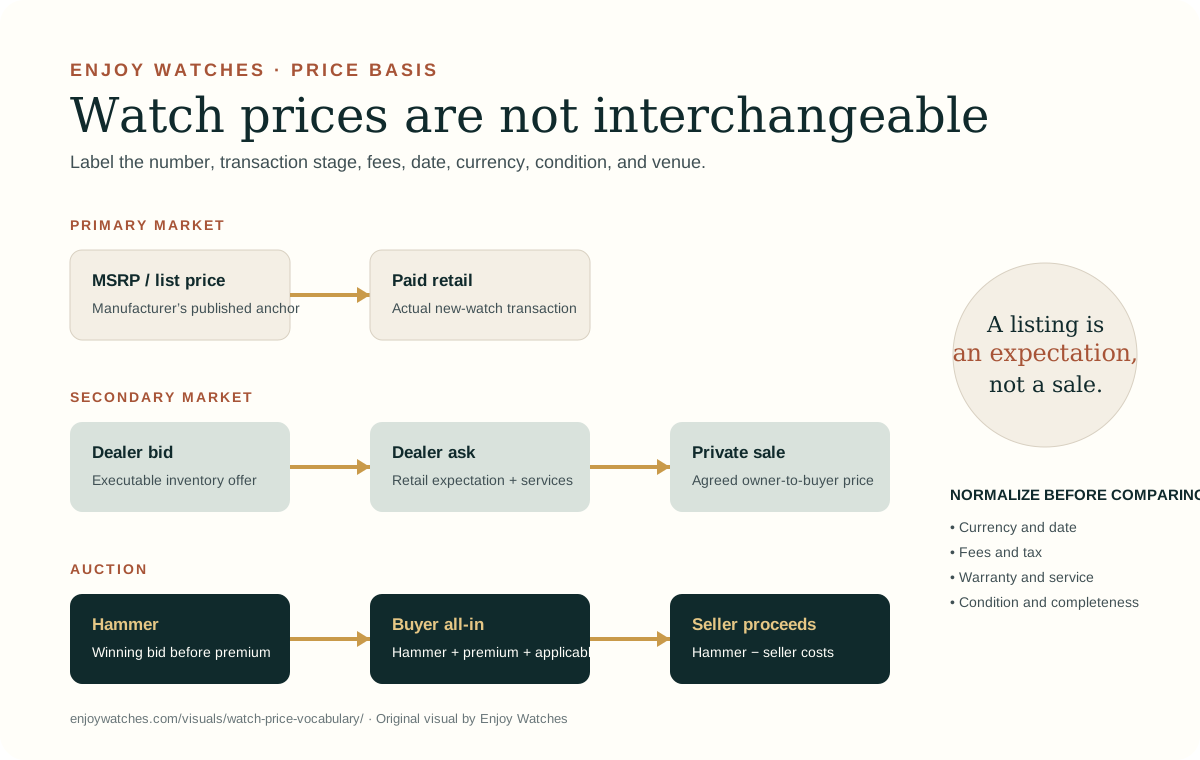
There is no single watch price. MSRP, a dealer’s asking price, a cash bid, an auction hammer and an index value answer different questions. Before comparing two numbers, identify the venue, date, currency, condition, included fees and whether money actually changed hands.
The phrase “market price” is useful only after those facts are defined. For a seller needing cash today it may mean the best executable dealer bid. For a buyer at retail it may mean the final price of a serviced, warranted example. For an analyst it may mean a modeled estimate from a specified transaction sample.
The essential watch-price dictionary
| Term | What it actually measures | What it does not prove |
|---|---|---|
| MSRP / list price | Manufacturer’s suggested price for a new watch in a market and period | Availability, resale value or what a buyer paid |
| Authorized retail price paid | Final price on a first-sale invoice from an official retailer | The price another customer can obtain |
| Dealer asking price | Public invitation to buy before any negotiation | A completed transaction or dealer acquisition cost |
| Dealer bid / buy price | Amount a dealer is prepared to pay, usually subject to inspection | Patient retail potential |
| Trade-in allowance | Credit offered against another purchase | A clean cash valuation; margin can move between both watches |
| Private-sale price | Negotiated amount between owner and buyer | A broadly reproducible price unless details are verified |
| Auction estimate | Pre-sale opinion of likely bidding, usually before premium and tax | A guarantee, reserve or seller proceeds |
| Auction reserve | Confidential minimum below which a lot generally will not sell | The house’s appraisal or a public bid |
| Hammer price | Final accepted auction bid before buyer’s premium | Buyer’s invoice or seller’s net proceeds |
| Price realized / all-in result | Usually hammer plus buyer’s premium | Consistent tax treatment or what the seller received |
| Insurance replacement value | Estimated cost to replace through an appropriate retail channel | Cash-sale value |
| Index value | Modeled movement of a defined basket or sample | Performance of every watch or an investable return |
If a source does not define its term, do not silently choose the most convenient interpretation.
MSRP is a historical retail anchor
MSRP belongs to the primary market: manufacturer, distributor and authorized retailer selling a new watch to its first owner. It can be helpful for understanding brand positioning and the premium or discount at that time.
It is not a standing offer from the manufacturer. A discontinued watch may later sell above its original list price because demand grew while supply became fixed. Another may sell far below list because fashion changed, service is expensive or many examples survive.
MSRP can also differ by country, tax convention, currency and effective date. “Retail was US$10,000” is incomplete unless the source says where, when and whether tax was included. If access required a long retailer relationship or purchase history, MSRP may not describe the acquisition cost available to an ordinary buyer.
Asking price is evidence of supply, not a sale
A dealer or marketplace ask tells you that a seller is willing to offer a watch at that number. It can be useful when studying current inventory, geographic differences and price reductions. It may include value that a peer-to-peer sale does not: authentication work, service, a return policy, financing, attractive presentation and a dealer warranty.
An ask can also remain online for months, be duplicated across dealer networks, include room for negotiation or refer to a watch that is no longer available. Use several credible asks to describe retail competition, not to declare a clearing price.
Ask these questions:
- Is the photographed watch the actual item?
- Is it in stock and immediately purchasable?
- Does the price include VAT or sales tax?
- What service, warranty and return rights are included?
- Is the seller open to offers?
- How long has the listing been active?
A dealer bid measures immediate liquidity
A real dealer bid answers: “What will a professional buyer risk its own capital on today?” The bid accounts for authentication, possible service, insurance, financing, marketing, returns, warranty and time in inventory. The difference between bid and retail ask is a gross spread from which those costs and risks must be paid—not automatic profit.
For a common, liquid and easy-to-grade watch, competing bids may cluster tightly. For an obscure reference, damaged watch or uncertain dial, bids can vary sharply because each dealer estimates risk and its customer base differently.
When comparing bids, confirm that each is:
- a cash offer rather than a trade allowance;
- based on the same disclosed condition and accessories;
- valid for a stated period;
- subject only to specified inspection points;
- net of payment, shipping or other deductions.
Auction numbers need labels
Suppose a watch receives a final bid of US$20,000 and the applicable buyer’s premium is 27%:
| Auction number | Amount |
|---|---|
| Hammer price | US$20,000 |
| Buyer’s premium | US$5,400 |
| Price realized before any tax | US$25,400 |
| Seller’s proceeds | Less than US$20,000 after seller deductions |
All three figures describe the same event, but none is interchangeable. Christie’s defines the sold or purchase price as hammer plus buyer’s premium in its auction glossary. A separate database may lead with hammer. Always retain the original sale currency and consult the exact sale’s fee schedule.
Auction results also have selection effects. Houses choose consignments likely to sell, exceptional provenance is overrepresented, and unsold lots are easier to overlook. A celebrity-owned record is not a valuation shortcut for an ordinary example of the model.
What a watch index can say
An index summarizes a defined market sample. It can show direction more clearly than a few anecdotes, but its construction determines its meaning.
WatchCharts says its overall index covers 300 watches from ten large brands, weighted using estimated transaction share. That is a deliberate, transparent selection—not the entire universe of wristwatches. Read the WatchCharts methodology before applying its headline to an obscure model.
Chrono24 says ChronoPulse is based on transactions within its platform and a selected model basket. That makes it more than an average of public asks, but it remains a sample of the platform’s users, models, geographies and rules. The ChronoPulse description should accompany any claim based on it.
An index is not automatically investable. A collector cannot necessarily purchase every constituent at the modeled value, hold condition constant, avoid service costs and then sell without a spread.
Normalize a comparable in seven steps
Turn every candidate sale into the same record:
- Object: exact reference, variant, material and approximate year.
- Condition: dial, case, movement, bracelet and known interventions.
- Completeness: boxes, papers, links, receipts and service history.
- Venue: auction, dealer, marketplace, private sale or trade-in.
- Price basis: ask, bid, hammer, premium-inclusive or seller net.
- Time and currency: sale date, original currency and conversion source if used.
- Services and obligations: tax, warranty, return rights, service and delivery.
Only then adjust for meaningful differences. A serviced dealer watch with a one-year warranty should not be marked down to an untreated private-sale price without recognizing the value and limits of those services.
A confidence ladder for price evidence
| Evidence | Confidence | Main caution |
|---|---|---|
| Current executable dealer bid | High for immediate liquidation | May change after physical inspection |
| Verified completed sale of the same configuration | High when recent and well documented | Venue and condition still matter |
| Several close premium-normalized auction results | Moderate to high | Selected consignments and changing fees |
| Current dealer asks from credible sellers | Moderate | Negotiation and time-to-sale unknown |
| Marketplace asking-price average | Low to moderate | Duplicates and stale listings |
| Social post, screenshot or “someone offered” claim | Low | Terms and authenticity cannot be checked |
The goal is not to find the highest number. It is to find the closest evidence for the decision being made. If you are selling, report a range with a fast-sale bid, an expected patient-sale net and the uncertainties separating them. If you are buying, compare the full cost and protections of obtaining the same-quality watch—not isolated stickers on a screen.
Sources and assumptions
Links checked August 24, 2026. Time-sensitive claims are scheduled for review by November 24, 2026.
- Christie’s — Auction glossaryRole: Commercial first-party policy. Scope: Supports only the named auction house's published terminology process or fee guidance at the source-check date; the actual sale agreement and live terms control.
- WatchCharts — Market index methodologyRole: Market data or methodology. Scope: Describes the commercial provider's published index method and covered sample; not the whole watch market or an appraisal of a particular watch.
- Chrono24 — ChronoPulseRole: Market data or methodology. Scope: Describes the platform's named index product and covered observations; not all transactions or a realizable price for a particular watch.
Send the claim and its source to [email protected]. Material corrections are logged. The contact page records the current mailbox-delivery limitation; retain your report until receipt is acknowledged.