

On this page
- A watch is a collectible asset, not a tiny stock
- Calculate the return you can actually receive
- Why watch-return headlines are often too generous
- What watch indexes do—and do not—measure
- The five risks buyers underestimate
- What tends to support value retention
- A pre-purchase investment audit
- A responsible conclusion
- Further reading
Image disclosure
Type: Generated editorial illustration. Creator: Created for Enjoy Watches using OpenAI image generation.
Prompt-directed synthetic still-life artwork; no real place, person, watch, or experience is represented. Illustrative only; not evidentiary photography or a source for claims.
About this guide
This guide is published under the organizational byline Enjoy Watches Research Desk. It does not list a named author or independent expert reviewer, and it is not an inspection, appraisal, authentication, or advice for a particular watch. Read the editorial policy before relying on it for a consequential decision.
Publication record
- Risk tier
- Tier 3 — Consequential guidance
- Risk topics
- investment, financial decision
- Independent review
- Not completed. Internal source checks are not represented as independent expert review.
- Published
- August 24, 2026
- Last substantive update
- No later substantive update is recorded.
- Source links checked
- August 24, 2026
- Next source review target
- November 24, 2026
Dates record publication and source-maintenance activity; they do not claim a named expert approval. See the risk-tier policy and corrections log.
Watches are not reliably good investments as a category. A small minority of references have appreciated dramatically, and some desirable watches may preserve value well. But a watch produces no cash flow, is costly to trade and maintain, and can lose value through fashion, condition, authenticity or market cycles.
Buy a watch primarily because its use and enjoyment justify the price. Treat appreciation as uncertain upside. If the purchase only works when a future buyer pays more, apply the same discipline you would to a concentrated, illiquid speculation—and include every cost.
A watch is a collectible asset, not a tiny stock
A share represents a claim on a business. A bond promises contractual payments. A watch is a physical good whose financial return comes entirely from what someone later pays for it, less ownership and selling costs.
That does not make watches worthless. They can deliver years of use, design pleasure, study, community and status. Economists would call this a consumption benefit. It is real, but personal: a future buyer does not reimburse you for the enjoyment you received.
| Characteristic | Collectible watch | Diversified public-market fund |
|---|---|---|
| Cash flow | None | Underlying businesses or bonds may generate income |
| Price discovery | Fragmented by venue and condition | Frequent exchange pricing |
| Liquidity | Days, months or longer; spread varies | Commonly tradable during market hours |
| Diversification | One watch is highly concentrated | Can hold hundreds or thousands of securities |
| Custody | Theft, damage, insurance and storage risk | Account and fund structure |
| Ongoing cost | Service, insurance, shipping, authentication | Fund fee, tax and trading cost |
| Personal use | High | None |
The 2026 UBS Global Investment Returns Yearbook describes equities as the top-performing liquid asset over its very long historical sample and emphasizes diversification and disciplined asset allocation. It is not a watch study, but it is a reminder that a collectible should be compared with realistic financial alternatives, not cash in a drawer. See the UBS yearbook overview.
Calculate the return you can actually receive
Do not calculate “return” as today’s dealer ask divided by yesterday’s MSRP.
Net profit = cash received on sale − purchase all-in cost − ownership costs − selling costs
Net return = net profit ÷ total cash invested
Include as applicable:
- tax, duty, shipping and currency conversion at purchase;
- dealer spread or auction buyer’s premium;
- servicing, parts, straps and bracelet links;
- insurance, secure storage and appraisal;
- authentication, archive research and photography;
- marketplace fee, seller’s commission or dealer discount at exit;
- insured delivery, tax and bank charges at sale.
A worked five-year example
Suppose a buyer pays US$10,000 all-in, spends US$1,000 on service and insurance over five years, then receives a US$12,000 dealer bid.
| Cash flow | Amount |
|---|---|
| Purchase | −US$10,000 |
| Ownership costs | −US$1,000 |
| Cash received on sale | +US$12,000 |
| Net profit | US$1,000 |
| Simple return on US$11,000 invested | 9.1% over five years |
The screen price rose 20% from US$10,000 to US$12,000, but the owner’s simple net return is 9.1% before any tax and before adjusting for inflation or the time value of money. If US$12,000 is merely another dealer’s asking price rather than an executable bid, the return has not yet been realized.
Why watch-return headlines are often too generous
Selection bias
A story may choose today’s most desirable Rolex, Patek Philippe or Audemars Piguet references and trace them backward. That selection rule was not available to a buyer at the start. Thousands of unfashionable, failed or ordinary watches disappear from the story.
Survivorship bias
The watches appearing in modern databases are more likely to be identifiable, saleable survivors. Damaged, scrapped, over-restored and unwanted examples are underrepresented.
Access bias
A chart may begin at MSRP even when the reference was not freely available to an ordinary buyer at that price. Relationship spending, waiting and opportunity cost are omitted.
Condition drift
An index treats a reference as a category, but physical watches age individually. A dial damaged by moisture or a heavily polished case cannot claim the return of a strong example.
Price-basis mismatch
Purchase MSRP, current retail ask, auction result including premium and seller proceeds are different numbers. A defensible study uses the same basis at entry and exit or explicitly normalizes the difference.
Unrecorded costs
Servicing a complication, insuring a valuable collection and selling through a dealer can consume years of nominal appreciation.
What watch indexes do—and do not—measure
Indexes are helpful when their samples and methods match the question. WatchCharts says its overall index uses 300 watches from ten large brands and weights them using estimated transaction share. Its index methodology makes clear that the basket is selective. It cannot describe every vintage, microbrand, fashion or low-liquidity watch.
Chrono24 says ChronoPulse derives from completed transactions on its platform for a selected basket. It therefore observes a meaningful slice of online activity, but still reflects the platform’s participating users, geographies, models and methodology. Read the ChronoPulse description before generalizing a movement to “the watch market.”
An index return is not automatically investable. You may be unable to acquire constituents at the modeled values, in index-like condition and weights, then exit without a spread. Changes to sample selection can also affect long histories.
The five risks buyers underestimate
| Risk | How it appears in watches | Practical defense |
|---|---|---|
| Liquidity | No bid near public asks; months to sell | Collect real dealer bids before buying |
| Authenticity | Counterfeit or assembled components | Independent expertise and documented inspection |
| Condition | Moisture, polishing, refinishing, worn movement | Grade components, not “overall condition” alone |
| Concentration | One brand, model or aesthetic falls from favor | Do not rely on a single watch for financial goals |
| Custody | Theft, loss, damage or disputed shipping | Suitable insurance, secure storage and transfer |
FINRA’s general guidance for alternative and emerging investments warns that limited liquidity, complexity, concentration and fees can impair outcomes. Physical watches are not the regulated products discussed on that page, but the risk questions transfer usefully: understand how you can exit, avoid overconcentration and count costs. See FINRA’s risk overview.
What tends to support value retention
No feature guarantees appreciation. Historically, the more resilient candidates often combine several of these:
- durable demand for the brand and model family;
- an exact, widely identifiable reference;
- strong condition with attractive original components;
- a large international buyer and dealer network;
- serviceability and available expertise;
- complete, coherent documentation;
- supply that is limited relative to real collector demand;
- a purchase price supported by completed comparables, not momentum alone.
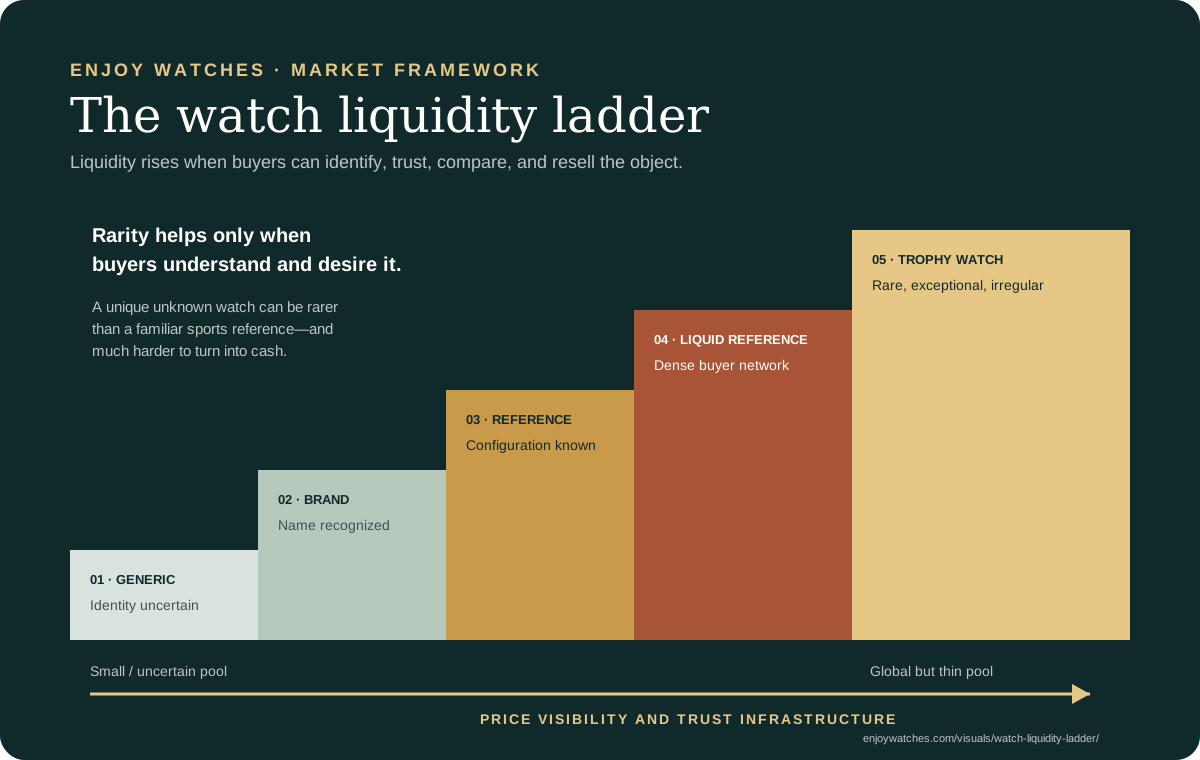
Rarity without demand is illiquidity. A unique unknown watch can be much harder to sell than a widely recognized model made in large numbers.
Be cautious when the thesis rests on one slogan: “discontinued always rises,” “limited edition means rare,” “steel beats gold,” “celebrity wore one,” or “the waitlist guarantees a premium.” Each statement ignores purchase price, surviving supply, condition and changing taste.
A pre-purchase investment audit
If financial outcome materially affects the decision, write down the answers:
- What exact reference and configuration am I buying?
- Which components are original, serviced, replaced or uncertain?
- What are three recent completed sales on the same price basis?
- What firm cash bid could I obtain today?
- What is the bid-to-ask spread in money and percentage terms?
- What service is likely during my intended holding period?
- What will insurance, storage and eventual sale cost?
- How long might a sale take in a weak market?
- Can I afford a substantial decline without needing to sell?
- Would I still want the watch if its resale price never rose?
That last question is the cleanest test. A watch that provides sufficient enjoyment can be a satisfying purchase even with a mediocre financial return. A watch that must appreciate to be affordable is carrying more risk than its polished case suggests.
A responsible conclusion
Watches can preserve or increase value, but the result belongs to a particular object bought at a particular price and sold through a particular channel—not to “watches” as one asset class. Use ranges, net proceeds and conservative costs. Keep financial goals in diversified, liquid assets appropriate to your circumstances, and treat a collectible allocation as money you can leave tied up.
This article is general education, not individualized financial, tax or legal advice. Rules and suitable allocations differ; consult a qualified adviser where the decision is material.
Further reading
Sources and assumptions
Links checked August 24, 2026. Time-sensitive claims are scheduled for review by November 24, 2026.
- FINRA — Alternative and emerging productsRole: Institutional reference. Scope: Supports FINRA's stated investor-risk guidance; applying its questions to physical watches remains an explicitly bounded editorial analogy.
- WatchCharts — Market index methodologyRole: Market data or methodology. Scope: Describes the commercial provider's published index method and covered sample; not the whole watch market or an appraisal of a particular watch.
- UBS — Global Investment Returns Yearbook 2026Role: Institutional reference. Scope: Supports the cited publication's stated long-run dataset and analysis; not a watch-specific benchmark recommendation or forecast.
- Chrono24 — ChronoPulseRole: Market data or methodology. Scope: Describes the platform's named index product and covered observations; not all transactions or a realizable price for a particular watch.
Send the claim and its source to [email protected]. Material corrections are logged. The contact page records the current mailbox-delivery limitation; retain your report until receipt is acknowledged.