
On this page
- A commercial timeline of the watch
- Before brands: the commissioned portable machine
- Pocket watches create a distributed industry
- The American System sells standardization
- Switzerland combines exports, trademarks and luxury
- The wristwatch changes who buys—and what a watch says
- Brands turn proof into stories
- Postwar prosperity makes the watch a milestone
- Quartz destroys the old value proposition
- Mechanical watches return as meaning
- The modern vintage market is surprisingly young
- Trophy results make provenance visible
- The internet makes watches legible at global scale
- The 2020–2022 boom tests the new market
- Why one old watch is valuable and another is not
- The central lesson
Image disclosure
Type: Generated editorial illustration. Creator: Created for Enjoy Watches using OpenAI image generation.
Prompt-directed synthetic still-life artwork; no real watch, document, person, institution, or outcome is represented. Illustrative only; not evidentiary photography or a source for claims.
About this guide
This guide is published under the organizational byline Enjoy Watches Research Desk. It does not list a named author or independent expert reviewer, and it is not an inspection, appraisal, authentication, or advice for a particular watch. Read the editorial policy before relying on it for a consequential decision.
Publication record
- Risk tier
- Tier 2 — Decision support
- Risk topics
- historical interpretation, market context
- Independent review
- Not completed. Internal source checks are not represented as independent expert review.
- Published
- August 24, 2026
- Last substantive update
- No later substantive update is recorded.
- Source links checked
- August 24, 2026
- Next source review target
- August 24, 2027
Dates record publication and source-maintenance activity; they do not claim a named expert approval. See the risk-tier policy and corrections log.
Watches became global luxury goods and collectibles through several different commercial revolutions. They began as costly, commissioned mechanisms for courts and wealthy households; became repairable consumer goods through specialist workshops; reached mass buyers through factories, catalogues and credit; acquired pricing power through trademarks, warranties and advertising; and survived quartz by being resold as craft, heritage and identity. The related history of watch brands explains why a familiar dial name can have separate workshop, trademark, ownership and revival histories.
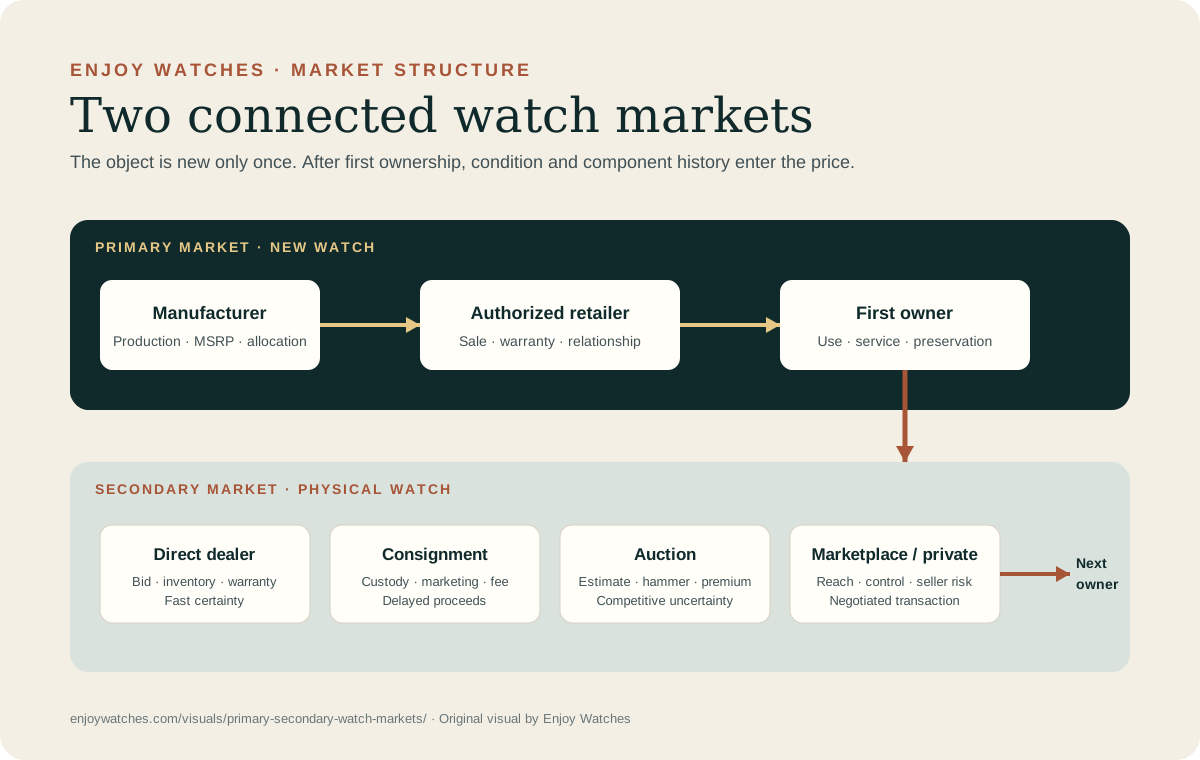
The modern secondary market came last. Dealers, collectors, auction catalogues, reference books, forums and online platforms taught buyers to distinguish one reference, dial and condition from another. A watch becomes liquid when enough people can identify it, trust it, compare it and sell it again—not simply when it is old or rare.
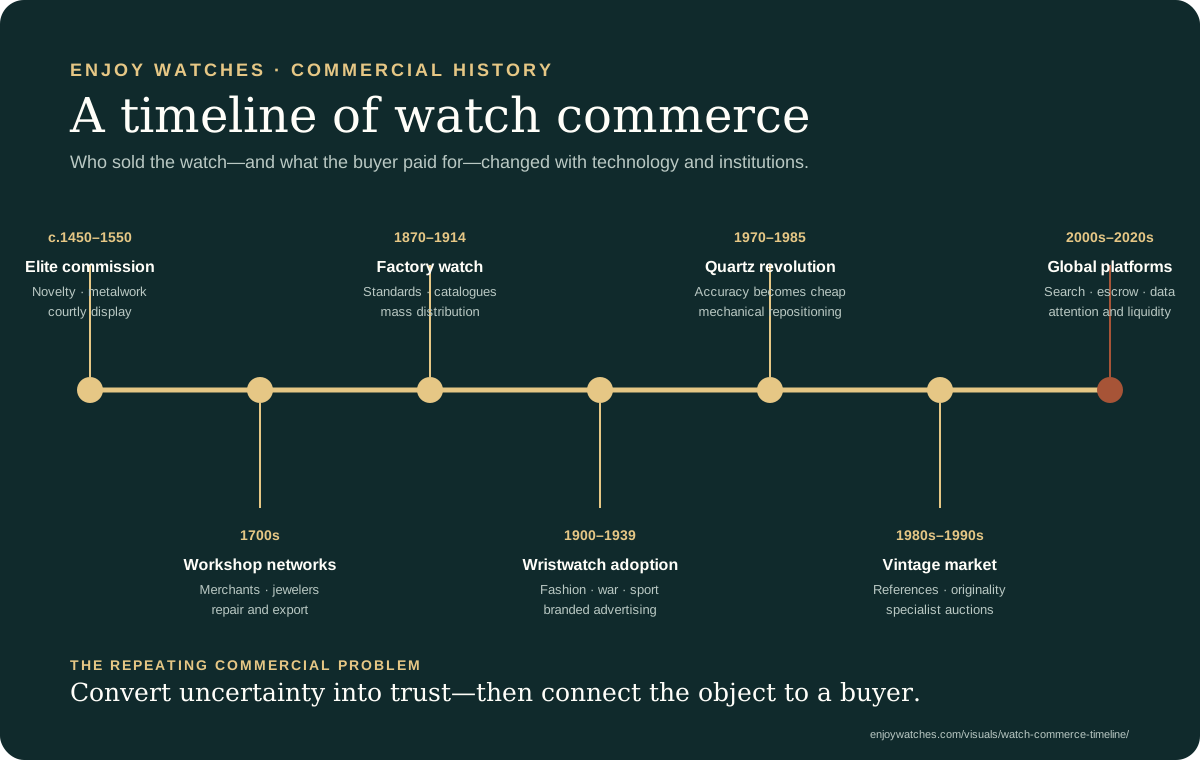
A commercial timeline of the watch
| Period | Typical product | Main buyer | How it was sold | Strongest source of value |
|---|---|---|---|---|
| c. 1450–1550 | Spring-driven portable clock or jewel | Court, prince, wealthy merchant | Commission through artisan and court networks | Novelty, metalwork, status |
| 1550–1700 | Pendant, table and decorative watch | European elite and gift market | Urban workshop, goldsmith, merchant, fair | Ornament and maker reputation |
| 1700–1800 | Mature pocket watch | Gentry, officers, professionals, merchants | Watchmaker, jeweler, overseas agent | Function, finish, material, credit |
| 1800–1870 | Mechanized and distributed pocket watch | Expanding middle class | Wholesaler, importer, jeweler | Reliability, falling price, repair |
| 1870–1914 | Factory watch and railroad grade | Mass consumer and transport worker | Dealer network, catalogue, installment plan | Standardized performance and guarantee |
| 1900–1939 | Branded wristwatch | Women, soldiers, motorists, urban consumers | Jeweler, department store, brand agent | Convenience, fashion, modernity |
| 1945–1969 | Automatic, waterproof and dress watch | Broad middle class and luxury buyer | Authorized retailer, duty-free, department store | Milestone gifting, aspiration, utility |
| 1970–1985 | Quartz watch; shrinking mechanical niche | Global mass consumer | Electronics and jewelry retail | Accuracy, low maintenance, price |
| 1985–2000 | Revived mechanical and emerging vintage watch | Luxury customer and enthusiast | Authorized dealer, fair, specialist, auction | Craft, heritage, complication, originality |
| 2000–2019 | Searchable new and pre-owned reference | International buyer | Boutique, dealer site, eBay, Chrono24, auction | Comparability, trust and global reach |
| 2020–2022 | Scarce, highly visible sports reference | Collector plus speculative entrant | Allocation, online dealer, social commerce | Immediate access, attention, momentum |
| 2022–present | Data-rich but selective resale market | More price-sensitive global buyer | Omnichannel dealer, platform, auction, CPO | Condition, liquidity and disciplined evidence |
This is not a straight march from cheap to expensive. Quartz made superior basic accuracy inexpensive. Many old mechanical watches lost practical and resale value before a smaller group was reclassified as collectible. Each era changed what buyers thought they were paying for.
Before brands: the commissioned portable machine
Portable spring-driven timepieces became saleable in Europe around the turn of the sixteenth century. Replacing the hanging weight of a fixed clock with stored spring power made mobility possible, but the surviving evidence does not support one inventor or one launch date. The Metropolitan Museum of Art places portable spring-driven clocks by about 1450 and watch-sized mechanisms incorporated into precious objects by the early sixteenth century. Its history of early European watches shows how closely mechanics and decorative art were joined.
The first market was narrow because making a watch required concentrated wealth. A patron financed skilled labor, precious metal, engraving, enamel, gem setting and repeated adjustment. Accuracy was limited and repair difficult. The buyer purchased miniaturization, novelty and visible mastery as much as reliable time.
“The maker” was often a network. One worker might produce part of the movement, another the case, another the dial or enamel, while a merchant arranged materials, credit and delivery. Clockmakers, watchmakers, goldsmiths, jewelers and engravers had overlapping roles. Guild standing, metal hallmarks, visible workmanship and personal recommendation substituted for factory warranty and public specifications.
Old watches circulated through inheritance, pawning, estate dispersal, repair shops and private exchange. This was a secondhand market, but not the modern vintage market. Age did not automatically create a premium; buyers might value the precious case, usable movement, association with an owner or opportunity to reuse parts.
Pocket watches create a distributed industry
By the eighteenth century, personal watches had spread beyond courts to merchants, professionals, officers and prosperous artisans. Expansion depended on division of labor. Movement makers, ébauche suppliers, wheel cutters, spring makers, dial makers, case makers, finishers, assemblers, merchants, importers and retail jewelers could all participate in one object.
This explains a puzzle modern collectors encounter: the dial signature may identify the retailer or final seller rather than every workshop behind the mechanism. A London-signed watch might incorporate work from several English specialists. A Swiss movement might be cased and named for the destination market. Private labeling was ordinary commerce, not inherently fraudulent.
Switzerland’s établissage system coordinated components from numerous specialist workshops. It reduced the capital required to offer a broad range and helped merchants adapt watches to different export markets. It also made origin and quality harder for distant customers to read. Commercial knowledge—who made reliable components, which styles sold abroad, how to extend credit—became as valuable as bench skill.
Production shaped whole places. La Chaux-de-Fonds and Le Locle organized homes, workshops and later factories around light, logistics and specialist collaboration; UNESCO recognizes their watchmaking town planning as an industrial landscape.
Prices fell as skills accumulated and production widened. Economists Morgan Kelly and Cormac Ó Gráda analyzed more than 3,200 watches described in London’s Old Bailey records from 1685 to 1810 and estimated a large long-run decline in real prices. Stolen-property valuations are not retail receipts, but the research supports a broad result: personal timekeeping became accessible to more people through specialization, learning and distribution. Their study of watch prices and industrialization also shows why watchmaking mattered beyond luxury history.
Repair was part of the business model. Oils degraded, springs broke and pivots wore. Local repairers earned recurring revenue, judged which watches were worth fixing, bought from estates and sometimes assembled usable parts. Their knowledge reduced risk for buyers. Service marks scratched inside case backs became informal maintenance records long before standardized paperwork.
The American System sells standardization
Nineteenth-century American firms changed the commercial promise. Instead of treating each movement as a largely hand-fitted object, they invested in purpose-built machinery, gauges, sequential factory organization and relatively interchangeable components. Waltham became the best-known demonstration in the 1850s. The Smithsonian describes it as the first successful mass production of watches through special machines and a factory system in Watches by Machine.
The complete history of watchmaking tools follows that change from files, turns and wheel-cutting engines through factory gauges, timing instruments, CNC and microfabrication. Its 326-entry index helps separate a workshop capability from a brand or marketing claim.
Interchangeability was relative, not magical: model changes created separate parts, and fitting was still required. Yet a named factory grade offered more consistency than an anonymous one-off movement. A jeweler could identify it, order parts and explain a quality tier. Serial production later gave collectors a way to date and compare surviving watches.
The factory moved financial risk. A court artisan might begin after receiving a commission; Waltham, Elgin, Hamilton and Illinois invested in machinery, wages and inventory before knowing the final customer. Wholesalers and jewelers stocked products and extended local trust. National advertising created demand for the manufacturer’s name, while catalogues and installment credit reached buyers far from factory towns.
Period newspapers digitized by the Library of Congress show jewelers offering several named American makes together. The manufacturer became legible, but the retailer still selected movements and cases, granted credit, guaranteed the sale and handled service.
Railroads made performance institutional. Coordinated train movement turned timekeeping into safety infrastructure. Rules differed by railroad and date, but inspectors could specify accuracy, legible dials, jewel count, positional adjustment, setting mechanism and regular examination. The commercial signal was stronger than “high quality”: the watch belonged to a recognized, inspectable class. A used grade remained understandable to another watchmaker or inspector.
Mass production did not make every surviving factory watch valuable. It created the conditions for price comparison. Abundant ordinary grades can remain inexpensive precisely because so many survive; scarce, identifiable configurations can attract collectors because the records reveal what they are.
Switzerland combines exports, trademarks and luxury
Swiss global dominance was built, not inherited whole. Flexible specialist production, accumulated skill, export merchants and adaptation to local cases, tariffs, hallmark rules and tastes helped Swiss watches enter many markets. Over time, some companies moved from supplying retailers toward owning the identity seen by the end customer.
Trademark protection made reputation portable. Longines, Omega, Zenith and Rolex developed names and symbols that could be defended and recognized across borders. Serial systems, catalogues, guarantees and repeatable model families made a brand promise easier to understand. Historian Pierre-Yves Donzé’s global business history of watchmaking traces this transformation from distributed industry to multinational brand management.
Precision tests and exhibitions turned technical performance into public evidence. Observatory competitions and chronometer certification supplied a vocabulary—adjusted, precision, observatory, chronometer—that brands could advertise. A submitted competition movement did not prove that every retail watch performed identically, but it linked the company name to measurable achievement.
The retailer’s trust did not disappear; it became authorized. Brands appointed dealers, supplied displays and training, connected warranty to the official channel and sought consistent presentation. The retailer gained access to demand and service support while accepting inventory and brand obligations.
Selective distribution also created grey-market opportunity. Whenever genuine watches carried different discounts, taxes, currencies or demand across territories, intermediaries could move stock outside the intended route. The internet later exposed these differences globally, but parallel distribution is older than e-commerce.
The wristwatch changes who buys—and what a watch says
For the source-critical history of the form itself, read the history of the wristwatch. This section follows the related but different question: how the wristwatch changed customers, distribution, and commercial meaning.
Moving the watch from pocket to wrist altered its economics. It became visible, instantly readable and tied to clothing, gender, work and movement. It needed a strap or bracelet, a smaller mechanism, legibility and better protection against dust, shock and moisture.
Women were early wristwatch customers, not a decorative footnote before the “real” male wristwatch. Bracelet and jewelry watches existed decades before the First World War. Breguet’s records describe Caroline Murat, Queen of Naples, commissioning a repeating bracelet watch in 1810, delivered in 1812. The object is lost, but the order is unusually well documented in the brand’s archival account.
Patek Philippe preserves an 1868 bracelet watch it describes more narrowly as the first Swiss wristwatch. Cartier’s Santos account connected a purpose-designed men’s wristwatch with aviation and later serial sale. These examples make “Who invented the wristwatch?” the wrong commercial question. Several early forms existed; some later became repeatable products with memorable stories.
Military use accelerated male adoption rather than inventing wrist wear. An officer could check time while handling reins, maps or equipment; artillery and coordinated movement rewarded shared time. After the First World War, advertising moved the form from battlefield practicality to civilian modernity. Driving, flying, sport, factory work and urban schedules all favored an at-a-glance display.
Visibility expanded brand value. A pocket watch could remain hidden; a dial and bracelet on the body could announce occupation, aspiration and taste. Manufacturers now sold not only time but an identity: pilot, diver, racing driver, explorer, executive or jewelry wearer.
Brands turn proof into stories
Twentieth-century pricing power came from promises that lasted beyond one transaction:
- recognizable designs and model families;
- documented performance and specifications;
- international warranties and service;
- associations with credible professions, sports and events;
- controlled retail presentation;
- continuity that made an older watch intelligible.
Rolex is an especially clear example. The company turned precision certificates, the Oyster case, automatic winding and professional model families into a consistent story of achievement. Other firms used different strengths: Cartier design, Patek Philippe complications and inheritance, Omega timing and exploration, Breitling aviation, Seiko industrial precision. The history matters less as a ranking than as evidence that brand value is manufactured through product, distribution and repeated communication.
Celebrity and event claims require care. A brand advertisement proves that the advertisement existed, not that the depicted person habitually wore the model. A military contract does not make every later watch “military issued.” The strongest stories connect a specific object to a specific person or event through documents.
Postwar prosperity makes the watch a milestone
After 1945, rising incomes, salaried work, consumer credit and international travel enlarged the market. Automatic winding, improved water resistance and recognizable dress and sports designs offered real everyday utility. Jewelers and department stores also sold watches as graduation, promotion, anniversary, retirement and corporate-service gifts.
Milestone selling created personal value that may diverge from market value. An engraved retirement watch can be priceless to a family and less attractive to an anonymous buyer. Boxes, receipts and photographs can later convert family memory into credible provenance, but sentiment alone is not a transferable price premium.
Luxury firms increasingly sold non-functional value: case design, precious materials, hand finishing, complications, packaging, cultural association and ownership ritual. Patek Philippe’s 1996 “Generations” campaign did not invent inheritance; it converted an existing behavior into a memorable global proposition.
Gender shaped both production and later collecting. Vast numbers of small, jewelry-led watches were sold to women, yet later collector media often privileged large men’s sports and military models. Resale value therefore reflects what communities chose to research and celebrate, not a neutral ranking of craft. As tastes shift toward smaller or less rigidly gendered sizing, previously overlooked categories can be reassessed—but not every neglected watch is therefore undervalued.
Quartz destroys the old value proposition
For a focused account of the industrial disruption and mechanical revival, see Quartz Crisis Explained. The point here is narrower: quartz changed what buyers could expect from an ordinary watch and therefore changed the commercial case for mechanical ones.
Seiko introduced the Quartz Astron 35SQ on December 25, 1969. It was expensive—Seiko compares its launch price with a popular car—but it showed a route to extraordinary accuracy using electronics. Read the Seiko Museum’s Astron history. Swiss groups also developed early quartz technology; the later outcome was not a simple tale of invention in Japan and ignorance in Switzerland.
As semiconductor and manufacturing costs fell, basic accuracy, convenience and low maintenance became inexpensive. Ordinary mechanical watches could no longer justify their market position by keeping better time. Japanese companies scaled quartz rapidly; many Swiss firms struggled with fragmented structures, high costs and legacy inventory. Employment and company counts contracted severely.
The effect on used watches was brutal but poorly indexed. Many mechanical pieces became unfashionable goods, gold cases were scrapped and dealers treated older stock as cheap repair or parts material. Anecdotes of bargain vintage purchases capture the atmosphere, but no comprehensive 1970s global resale index exists.
Swiss recovery involved consolidation, financing, automation, movement supply and a portfolio ranging from inexpensive Swatch quartz to revived luxury houses. “Swatch saved Switzerland” is memorable but incomplete. Organization and brand strategy were as important as one colorful plastic product.
Mechanical watches return as meaning
Mechanical watches revived without regaining superiority at basic timekeeping. Firms and tastemakers changed the comparison. The visible movement became craft; obsolete technique became heritage; difficult complications became proof of skill; continuity became authenticity.
Ryan Raffaelli’s study of Swiss mechanical watchmaking describes this as technology reemergence: institutional actors reconstructed value around a technology once displaced by quartz. His research on the mechanical revival explains why a technically superseded object could return at higher prices.
High complications, hand finishing, limited production and independent makers offered new reasons to buy. Magazines, trade fairs, collector clubs and auction catalogues taught customers the language of perpetual calendars, repeaters, column wheels, anglage, enamel and guilloché. Education supported commerce: once buyers could perceive a distinction, they could price it.
Scarcity alone was insufficient. A numbered edition without demand could fail, while a non-limited but consistently desired model might remain liquid. Commercial scarcity requires recognition, credible quality and a buyer pool.
The modern vintage market is surprisingly young
People have traded and collected old watches for centuries. The modern vintage wristwatch market—organized around reference numbers, dial variants, original lume, unpolished cases, boxes and papers, specialist dealers and published comparables—is largely a late-twentieth-century institution.
A defensible periodization is:
- 1940s–1950s: horological institutions and scholarship mature;
- 1960s–1970s: antique dealers expand while mechanical watches lose everyday status;
- late 1970s–1980s: a recognizable specialist wristwatch trade and dedicated auctions emerge;
- 1990s: books, magazines, auction catalogues and early forums standardize reference knowledge;
- 2000s onward: global search greatly expands price visibility and liquidity.
Antiquorum, founded in Geneva in 1974, says it pioneered wristwatch-focused auctions in the early 1980s. Its 1989 thematic Patek Philippe sale helped treat watches as a coherent field deserving research, photography and historical narrative; see the house’s institutional history.
Auction houses did more than announce records. Their catalogues converted private objects into public evidence: case and movement numbers, photographs, provenance claims, estimates, condition observations and results. Repeated descriptions taught collectors which attributes mattered. They also created feedback: once buyers paid more for a certain dial or untouched case geometry, owners and dealers searched for the same traits.
Catalogue authority is not infallibility. An attractive but unsupported attribution can be repeated into apparent fact. Conditions of sale also preserve buyer responsibility for repairs, replaced parts and uncertain working order.
Trophy results make provenance visible
Auction catalogues can make a particular object visible, but they do not turn every result into a comparable. How watch auctions work explains the separate buyer, seller, fee, reserve, and settlement terms behind a public result.
Some auction records changed expectations because they demonstrated the price of an exceptional attribute, not an ordinary model.
| Watch | Public result | What the market was buying |
|---|---|---|
| Patek Philippe Henry Graves Jr. Supercomplication, 2014 | CHF 23.237 million including premium | Unique commission, complication, named provenance and repeated validation |
| Stainless-steel Patek Philippe ref. 1518, 2016 | CHF 11.002 million including premium | Extreme configuration rarity and collector preference for steel |
| Paul Newman’s Rolex Daytona ref. 6239, 2017 | US$17.7525 million including premium | Direct ownership, inscription, family provenance and cultural significance |
The published totals come from the auction houses’ own records: Sotheby’s reports the 2014 Graves result, while Phillips documents the steel ref. 1518 and Paul Newman Daytona. These are exceptional all-in results, not ordinary model comparables.
The Phillips catalogue for Paul Newman’s Daytona shows why “same reference” is not “same value.” His personal watch embodied the history behind the collector nickname. Its result cannot be applied to every Daytona, but it proves how documented ownership can transform an object.
The internet makes watches legible at global scale
The terms used by dealers, platforms, and auction houses describe different transaction moments. Use the watch price vocabulary before comparing an online ask, a dealer bid, a hammer price, a buyer all-in total, and seller proceeds.
Before broad internet adoption, a collector’s effective market depended on local dealers, fairs, paper lists, auction catalogues, phone relationships and travel. The web made images, listings and peer discussion abundant.
eBay’s global auction format brought estate sellers, casual owners, dealers and collectors into one searchable venue. Forums accumulated reference photographs, service experiences and seller reputations. Chrono24’s watch-specific marketplace connected international dealer inventory and private listings. Digital photography let buyers compare small dial and case details that once required travel.
The internet reduced some information asymmetry and scaled new kinds. Stolen photographs, forged papers, undisclosed restoration, shill bidding, paid influence and stale asking prices could now travel globally. A screen full of listings created the appearance of precise value even when few watches sold at the displayed prices.
Price data improved in the 2010s and 2020s. Platforms began using completed transactions, auctions built searchable archives and firms modeled reference-level prices. Yet each dataset remains a slice. Auction databases overrepresent important consignments; dealer asks reveal supply expectations; platform indexes reflect their own users and model selection; immediate bids measure liquidity rather than polished retail potential.
The 2020–2022 boom tests the new market
Pandemic-era savings, spending shifts, constrained authorized availability, online access, social visibility and gains in other assets combined to lift demand for a concentrated group of recognizable watches. Federal Reserve and Bureau of Economic Analysis records support the unusual household-liquidity and saving context, but do not measure how much watch demand came from any single cause. For scarce references, MSRP stopped describing a price available on demand. The official channel allocated at list; the secondary market priced immediate access.
Rising prices then attracted speculative buying. Dealer inventory appreciated, waitlists became cultural proof of desirability and public asks chased momentum. The cycle did not move every watch equally: demand centered on a limited number of brands, sports references and fashionable independent makers.
After spring 2022, tighter financial conditions and changing consumption weakened momentum. Bids fell faster than many public asks, demonstrating a recurring truth: displayed price is not liquidity. Chrono24 later reported a substantial decline from its platform’s April 2022 peak before broader stability in 2024; that platform-specific account does not describe every watch or private transaction. The greatest declines often appeared where premiums over official retail had become most extreme.
The boom and correction did not turn watches into stocks. They showed that highly recognizable references can behave like financial assets for a time while retaining physical spreads, condition differences and irregular trading.
Why one old watch is valuable and another is not
Five kinds of value have accumulated across this history:
| Value | The buyer is paying for | Typical evidence |
|---|---|---|
| Functional | Useful or unusual timekeeping capability | Accuracy, reliability, legibility, complications |
| Material | Precious metal, gems and workmanship | Hallmarks, weight, gem and case quality |
| Brand | Recognition, trust, design continuity and service | Trademark, model family, distribution and records |
| Collector | Scarcity plus community demand for a configuration | Completed comparables, condition, originality |
| Provenance | A documented history that distinguishes this object | Receipts, archives, photographs, correspondence |
These values can conflict. A restored watch may work better and be worth less to an originality-focused collector. A rare steel configuration can outprice gold. An unknown unique watch can be harder to sell than a common but recognized reference.
The missing sixth factor is the cost of proof. Buyers pay more readily when reference, components, condition and ownership can be established. This is why reference systems, specialist knowledge, auction records and trusted intermediaries have economic value of their own.
The central lesson
The history of selling watches is a history of changing trust. Reputation and precious metal supported the court commission. Local repair and merchant networks supported the pocket watch. Factory grade and inspection supported mass production. Trademark, warranty and advertising supported the global brand. Catalogues, communities and data support the modern secondary market.
The next chapter will not remove uncertainty. Read the future-of-selling-watches scenario guide for a source-bounded view of which records, certification systems and market data may change - and which object-level questions will still need human judgement.
No stage removed uncertainty; each relocated it. Today a buyer can identify a reference in seconds and still misunderstand a refinished dial, a premium-inclusive result or an influencer’s incentive. The best protection is the same discipline that built the market: identify the object, state what is known, separate kinds of price, preserve evidence and treat a compelling story as a claim to verify.
Sources and assumptions
Links checked August 24, 2026. Time-sensitive claims are scheduled for review by August 24, 2027.
- The Metropolitan Museum of Art — Seventeenth-Century European WatchesRole: Institutional reference. Scope: Supports the cited institution's object record or historical interpretation within its stated scope; not a universal chronology or conclusion about a reader's watch.
- Smithsonian — Watches by Machine: The Waltham SystemRole: Institutional reference. Scope: Supports the cited institution's object record or historical interpretation within its stated scope; not a universal chronology or conclusion about a reader's watch.
- Pierre-Yves Donzé — The Business of TimeRole: Academic research. Scope: Supports only the cited work's stated evidence sample period and analysis; not a current market or individual-watch conclusion.
- UNESCO — Watchmaking town planning of La Chaux-de-Fonds and Le LocleRole: Government or intergovernmental source. Scope: Supports the cited heritage listing and its stated rationale; not a complete commercial history of the region or industry.
- Morgan Kelly and Cormac Ó Gráda — Adam Smith, Watch Prices, and the Industrial RevolutionRole: Academic research. Scope: Supports only the cited work's stated evidence sample period and analysis; not a current market or individual-watch conclusion.
- Library of Congress — Evening Star watch advertisements, October 30, 1908Role: Government or intergovernmental source. Scope: Provides the cited digitized historical newspaper page as a primary record for that date; not a complete survey of the market or every advertisement.
- Breguet — Caroline Murat wristwatch commissionRole: Commercial first-party record. Scope: Supports the maker or corporate museum's own published historical record or claim; commercial provenance is visible and independent corroboration may still be required.
- Patek Philippe — The first Swiss wristwatchRole: Commercial first-party record. Scope: Supports the maker or corporate museum's own published historical record or claim; commercial provenance is visible and independent corroboration may still be required.
- Cartier — The Santos storyRole: Commercial first-party record. Scope: Supports the maker or corporate museum's own published historical record or claim; commercial provenance is visible and independent corroboration may still be required.
- Patek Philippe — The Generations campaignRole: Commercial first-party record. Scope: Supports the maker or corporate museum's own published historical record or claim; commercial provenance is visible and independent corroboration may still be required.
- Seiko Museum Ginza — The Quartz Watch and AstronRole: Commercial first-party record. Scope: Supports the maker or corporate museum's own published historical record or claim; commercial provenance is visible and independent corroboration may still be required.
- Ryan Raffaelli — Technology ReemergenceRole: Academic research. Scope: Supports only the cited work's stated evidence sample period and analysis; not a current market or individual-watch conclusion.
- Antiquorum — HistoryRole: Commercial first-party record. Scope: Supports the organization's own published institutional history; not independent proof of every historical claim.
- Sotheby’s — Henry Graves Supercomplication resultRole: Commercial first-party record. Scope: Supports the named house's published record for that specific lot and stated price basis; not a comparable for another watch without adjustment.
- Phillips — Patek Philippe ref. 1518 resultRole: Commercial first-party record. Scope: Supports the named house's published record for that specific lot and stated price basis; not a comparable for another watch without adjustment.
- Phillips — Paul Newman Daytona resultRole: Commercial first-party record. Scope: Supports the named house's published record for that specific lot and stated price basis; not a comparable for another watch without adjustment.
- Federal Reserve — Household liquidity contextRole: Government or intergovernmental source. Scope: Supports the cited speaker's published macroeconomic context at the stated date; not evidence of watch prices demand or future returns.
- US BEA — Personal income and outlays, March 2021Role: Government or intergovernmental source. Scope: Supports the named US statistical release and period; not a watch-market dataset or causal conclusion.
- Chrono24 — 2024 platform price updateRole: Commercial first-party editorial analysis. Scope: Supports the platform's own dated market commentary and reported platform perspective; not independent market-wide evidence or a forecast.
Send the claim and its source to [email protected]. Material corrections are logged. The contact page records the current mailbox-delivery limitation; retain your report until receipt is acknowledged.