On this page
- The distinction in practical terms
- Authentication is a claim-matching process
- Use an evidence stack
- Terms sellers and buyers should use precisely
- What photographs can and cannot establish
- Papers and archive extracts support—but do not replace—the object
- A safe owner-level screening workflow
- Red flags that justify a pause
- How authenticity and originality affect value
- What a useful assessment should say
- Further reading
Image disclosure
Type: Generated editorial illustration. Creator: Created for Enjoy Watches using OpenAI image generation.
Prompt-directed synthetic still-life artwork; no real watch, maker, examination, or result is represented. Illustrative only; not evidentiary photography or a source for claims.
About this guide
This guide is published under the organizational byline Enjoy Watches Research Desk. It does not list a named author or independent expert reviewer, and it is not an inspection, appraisal, authentication, or advice for a particular watch. Read the editorial policy before relying on it for a consequential decision.
Publication record
- Risk tier
- Tier 3 — Consequential guidance
- Risk topics
- authentication, originality, valuation
- Independent review
- Not completed. Internal source checks are not represented as independent expert review.
- Published
- August 24, 2026
- Last substantive update
- No later substantive update is recorded.
- Source links checked
- August 24, 2026
- Next source review target
- November 24, 2026
Dates record publication and source-maintenance activity; they do not claim a named expert approval. See the risk-tier policy and corrections log.
Authenticity asks whether the watch and its represented parts are genuinely what the seller claims. Originality asks whether those parts and surfaces remain as the watch left production, or at least as they were first sold. A genuine watch can contain legitimate service replacements and therefore be authentic but not fully original.
Neither question is usually answered by one logo, serial number, card or photograph. Assess the claim component by component and report the limits of the evidence.
An unidentified watch is not ready for an authenticity conclusion. First build a visible-evidence identification record, then use the reference-number guide to separate model, serial, caliber, case and bracelet identifiers without treating any number as proof.
The distinction in practical terms
| Example | Authentic? | Fully original? | How it should be described |
|---|---|---|---|
| Correct watch with its surviving production-era components | Potentially, subject to inspection | Potentially | State the evidence; avoid absolute “untouched” claims without history |
| Correct watch with a genuine factory service dial and hands | The watch and parts may be authentic | No, if replacements were not fitted when first sold | “Genuine service dial and hands,” if established |
| Correct case and movement with a period-correct dial from another example | Parts may each be authentic | No | “Period-correct replacement dial; not proven original-to-watch” |
| Genuine movement in an incorrect or fabricated signed case | Not authentic as represented | No | Describe the assembly plainly; do not market it as the claimed reference |
| Original dial that has been repainted | The dial base may be genuine | Original surface and printing are lost | “Refinished/redial,” with scope of work if known |
| Correct watch with an aftermarket bezel | Core watch may be authentic | No | Disclose the aftermarket component prominently |
| Reissue made and signed by the original brand | Authentic reissue | Original as that later reissue, not a period vintage watch | Give the modern reference and production context |
“Authentic” is not a synonym for “collectible,” “valuable,” “working” or “water-resistant.” “Original” is not a guarantee of safe operation.
Authentication is a claim-matching process
Begin by copying the seller’s exact claim. Compare these very different statements:
- “an authentic Omega watch”;
- “an authentic reference X with a later service bracelet”;
- “all components original to the watch”;
- “unpolished and untouched since first sale”; and
- “owned by a named person.”
Authentication should answer whether the observed object is consistent with the stated maker, reference, period, configuration and history—not whether it merely resembles examples online.
Use an evidence stack
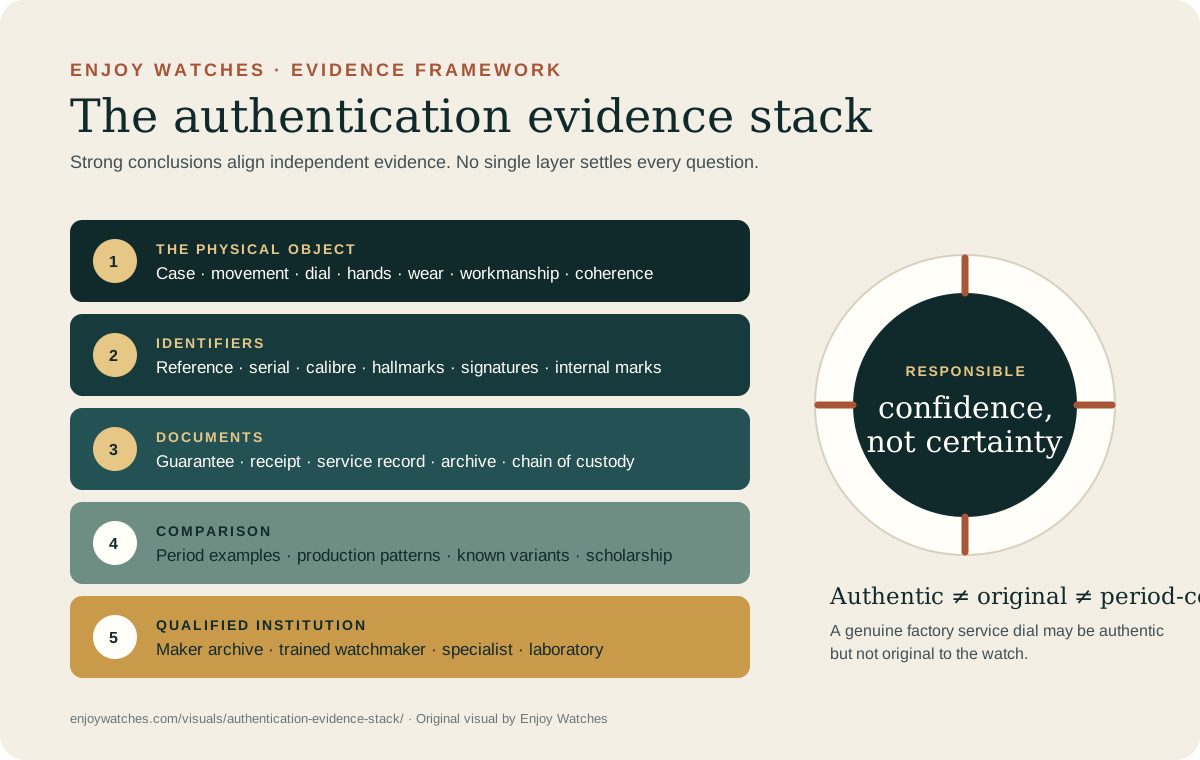
A defensible assessment combines five layers.
1. Object evidence
Inspect case construction, movement architecture, dial printing, hands, luminous material, hallmarks, engravings, finishing, wear and tool marks. Aging should be physically plausible and coherent across components, but matching color alone does not prove shared history.
2. Identifier evidence
Check the location, format, typography and sequence of reference, serial, case, movement, bracelet, clasp and import numbers. A plausible number is one piece of evidence. Numbers can be copied, altered, transplanted or paired with the wrong components.
3. Document evidence
Compare the guarantee, receipt, service invoices, archive extract, correspondence and dated photographs with the object. Look for agreement among numbers, dates, retailer, model, material and ownership chain.
4. Comparative evidence
Use period catalogues, manufacturer records, known examples and careful reference scholarship. Compare the correct production window; a feature may be legitimate for one generation and impossible for another.
5. Institutional evidence
A manufacturer record, respected reference specialist, competent watchmaker, auction warranty, established dealer guarantee or platform inspection can reduce uncertainty. Read the exact scope. An institution may authenticate the watch as a whole while excluding individual components, condition, timekeeping or water resistance.
Strong conclusions appear when independent layers agree.
Terms sellers and buyers should use precisely
| Term | Useful meaning | Valuation caution |
|---|---|---|
| Genuine/authentic | Made by or legitimately for the represented maker | Still assess each major component and the exact claim |
| Original-to-watch | Believed to have been fitted to this specific watch when first sold | Strong claim; requires more than period correctness |
| Period-correct | Correct type and era, but not proven to have started on this watch | Better evidence than an incorrect modern part, weaker than original-to-watch |
| Service part | Genuine replacement supplied through manufacturer service | May improve function while reducing vintage originality |
| Aftermarket | Made outside the manufacturer’s authorized parts system | Can affect value, fit, representation and sometimes safety |
| Redial/refinished dial | Dial repainted, reprinted or substantially resurfaced | Often loses original surface evidence even when attractive |
| Relumed | Luminous material replaced or renewed | Disclose location and extent; matching color is not proof of age |
| Frankenwatch | Assembly of parts not originally together, often across periods or references | Severity depends on compatibility, representation and disclosure |
| Restored | Mechanically or cosmetically changed to recover function or appearance | Too broad by itself; list every known intervention |
| “Untouched” | Market claim of exceptional preservation | Rarely provable from photographs alone |
Avoid “replica” as a soft substitute for counterfeit. Unless an authorized reproduction is clearly identified, the word often obscures the core issue: an object made or signed to deceive buyers about origin.
What photographs can and cannot establish
Good images can reveal typography, component type, case proportions, corrosion, obvious replacement parts and inconsistencies worth investigating. They usually cannot prove:
- that a component has always belonged to the watch;
- movement condition beneath bridges or dial;
- the metallurgy or depth of an engraving;
- whether surfaces were lightly refinished in the past;
- the complete service history;
- title and chain of custody; or
- current water resistance.
Major auction terms make similar limitations explicit. Phillips states that photographs are for identification and may not convey full condition, while prior repairs can make component authenticity difficult to guarantee (Phillips conditions).
Use remote review for triage, not photographic certainty. For a consequential transaction, arrange an in-person examination by someone experienced with that maker and period.
Papers and archive extracts support—but do not replace—the object
A correct document can strengthen identity, date and provenance. It can also be separated from its original watch, altered or forged. Check whether the document’s numbers, material, dial, retailer and dates agree with one another and with the object.
Manufacturer documents differ in scope. Patek Philippe describes its Certificate of Origin as the original document delivered with a new watch, while its later Extract from the Archives is a partial transcript of historical records (Patek Philippe FAQ). The distinction is a useful warning for every brand: read what a document certifies, not what a seller implies it certifies.
A document recording the watch at production does not automatically certify every component fitted today. Learn how to assess sets in the box-and-papers guide. A historic brand name can also have separate workshop, trademark and revival stories; use the watch-brand history guide before treating heritage language as component evidence.
A safe owner-level screening workflow
Step 1: Preserve the watch
Do not polish, clean the dial, relume, replace components or discard the strap and old parts. Photograph the watch and accessories as received.
Step 2: Record, do not force
Capture visible marks and measurements. Do not pry open a case, remove a tight bracelet or run complications you do not understand. A slip can damage the object, and some older luminous materials require specialist handling.
Step 3: Create a component map
For each major part, assign only one status:
| Component | Status choices |
|---|---|
| Case and caseback | Original-to-watch / period-correct / service / aftermarket / uncertain |
| Movement | Correct and matching / correct but unmatched / incorrect / uncertain |
| Dial | Original surface / service / redial / aftermarket / uncertain |
| Hands and lume | Original / service / relumed / mixed / uncertain |
| Crown, pushers and bezel | Original / service / period-correct / aftermarket / uncertain |
| Bracelet and clasp | Original-to-watch / correct period / later genuine / aftermarket / uncertain |
“Uncertain” is a valid finding. Do not upgrade it because the parts look consistent.
Step 4: Compare independent references
Use period-correct sources and more than one known example. Dealer listings often copy earlier errors; ten repeated descriptions may trace back to one unsupported claim.
Step 5: Escalate the decisive uncertainty
Ask a focused question: “Is this dial surface period-original?” is more useful than “Is my watch real?” Choose a specialist who can explain the observed features, comparison set and inspection limitations.
Red flags that justify a pause
- A seller discourages inspection or refuses clear identifier and movement evidence.
- The deal depends on urgency, secrecy or a price far below plausible market levels.
- Fonts, engravings or reference details conflict with known examples from the period.
- The dial, hands and case appear to have identical artificial aging without history.
- Documents disagree with the watch or show implausible dates, retailer details or printing.
- The seller treats a box, card or serial lookup as conclusive proof.
- The movement, case and dial each belong to plausible products but not the same reference.
- A valuable provenance story has no independent chain of evidence.
- Authentication language is broad, while component exclusions are buried in terms.
A red flag is a reason to investigate, not automatic proof of fraud.
How authenticity and originality affect value
The effect is reference- and buyer-specific. A genuine service crown may be routine on a daily wearer. A service dial can materially change demand for a rare vintage reference. A disclosed, competently assembled period-correct watch may still be enjoyable and saleable, but should not be priced or described as original-to-watch.
Use completed sales that match the same component status. Do not add or subtract a universal “originality percentage.” If comparable evidence is scarce, present scenarios and widen the range.
What a useful assessment should say
A good written conclusion includes:
- the exact claim examined;
- what was inspected physically and remotely;
- the reference material used;
- a status for each material component;
- inconsistencies and unresolved questions;
- the scope of any institutional guarantee; and
- a confidence level, not a promise of certainty.
An honest conclusion may read: “The case and movement appear consistent with the stated reference based on physical inspection; the dial is period-correct but cannot be established as original-to-watch; the later genuine bracelet is disclosed.” That is more useful than a certificate that says only “authentic.”
Authentication protects the transaction when its language is narrower than its evidence. Originality protects history when owners preserve components and disclose change. Keeping those ideas separate is the foundation for both.
Further reading
Sources and assumptions
Links checked August 24, 2026. Time-sensitive claims are scheduled for review by November 24, 2026.
- Patek Philippe Extract from the Archives FAQRole: Commercial first-party policy. Scope: Supports the maker's own archive-service definition eligibility and limits; not present-condition evidence or independent authentication of a watch.
- Phillips Geneva Online-Only Watches Conditions of Sale (effective April 12, 2026)Role: Commercial first-party policy. Scope: Supports the named house's stated conditions for the identified sale format and date; not universal auction terms or a quote for another transaction.
Send the claim and its source to [email protected]. Material corrections are logged. The contact page records the current mailbox-delivery limitation; retain your report until receipt is acknowledged.