On this page
Image disclosure
Type: Generated editorial illustration. Creator: Created for Enjoy Watches using OpenAI image generation.
Prompt-directed synthetic still-life artwork; no real watch, maker, examination, or result is represented. Illustrative only; not evidentiary photography or a source for claims.
About this guide
This guide is published under the organizational byline Enjoy Watches Research Desk. It does not list a named author or independent expert reviewer, and it is not an inspection, appraisal, authentication, or advice for a particular watch. Read the editorial policy before relying on it for a consequential decision.
Publication record
- Risk tier
- Tier 3 — Consequential guidance
- Risk topics
- valuation, physical safety, authentication
- Independent review
- Not completed. Internal source checks are not represented as independent expert review.
- Published
- August 24, 2026
- Last substantive update
- No later substantive update is recorded.
- Source links checked
- August 24, 2026
- Next source review target
- November 24, 2026
Dates record publication and source-maintenance activity; they do not claim a named expert approval. See the risk-tier policy and corrections log.
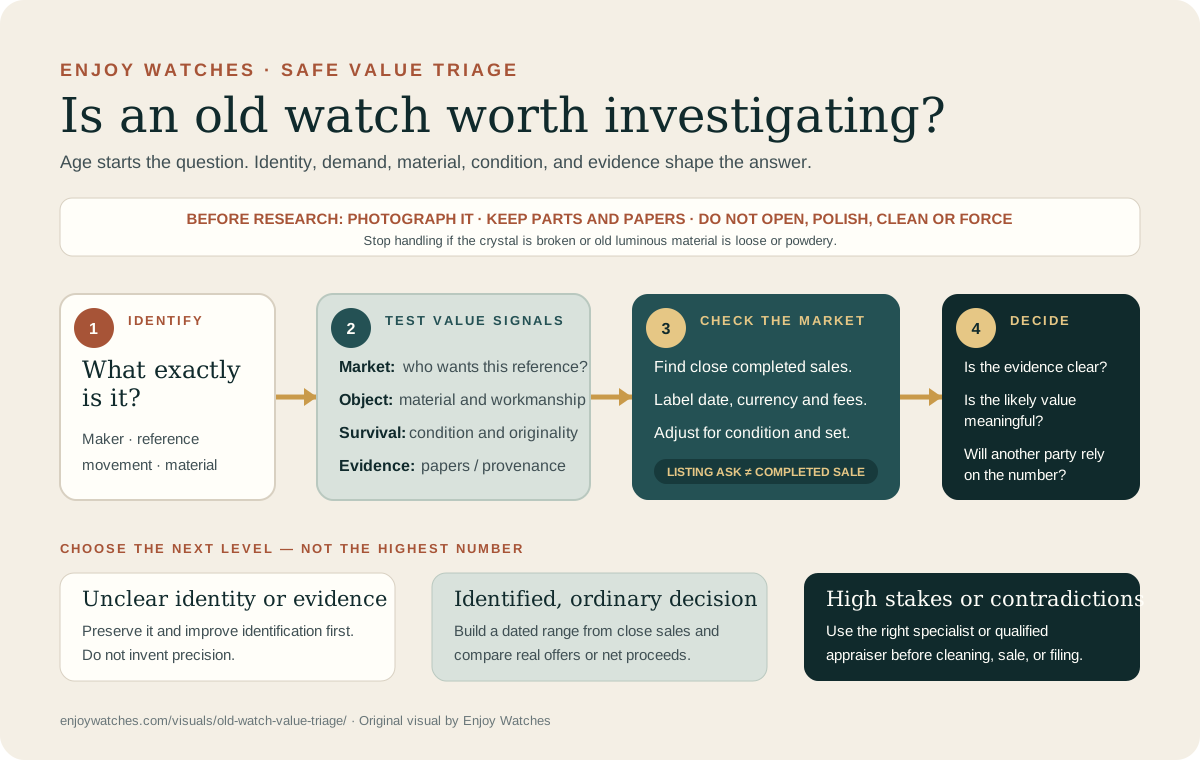
Some old watches are worth substantial money, but most are not valuable simply because they are old. The useful clues are an identifiable maker and reference, a wanted design or complication, precious materials, good condition, surviving original components, and documented history. Preserve the watch as found, identify it accurately, and compare completed sales before trusting a price.
An unsigned pocket watch can have material or historical interest. A familiar luxury name can still describe a damaged, altered, counterfeit, or low-demand watch. The question is not “How old is it?” but “Exactly what is it, what survives, who wants it, and what have comparable examples actually sold for?”
A five-minute triage
Do not open, wind, clean, polish, or test the watch yet. In good light, photograph the front, back, sides, crown, bracelet or strap, clasp, engravings, and every box or document. Then record only what you can see safely.
| Clue | Why it deserves investigation | What it does not prove |
|---|---|---|
| Recognized maker or retailer signature | May lead to a specific reference and established collector market | Authenticity, rarity, or high value |
| Reference, case, or movement number | Can identify generation, material, and configuration | That every current component left the factory together |
| Complication such as chronograph, calendar, repeater, or unusual display | Some mechanisms and designs attract specialist demand | That it works correctly or is expensive |
| Precious-metal hallmark | May establish case material and a material-value floor | Solid metal without testing, or collector value |
| Distinctive dial, military mark, presentation engraving, or unusual case | Can point to a scarce or historically interesting variant | A premium without independent evidence |
| Original guarantee, receipt, service record, or old photograph | Can strengthen identity, completeness, and provenance | That the watch has never been altered |
| Heavy wear but coherent period components | Collectors may prefer honest survival to aggressive restoration | That all wear is desirable or the watch is safe to run |
If none of these clues is obvious, the watch may still merit identification. Many makers signed the movement or inside case rather than the dial, and some retailer-signed watches require specialist knowledge. Do not use a kitchen knife or improvised tool to find those marks.
First, avoid irreversible damage
The safest valuable-watch behavior is also sensible for an ordinary old watch: preserve information before changing the object.
- Do not polish the case or bracelet. Refinishing can soften edges, remove metal, reduce hallmark definition, and erase evidence of earlier finishing.
- Do not clean the dial, hands, or movement. These surfaces can be fragile, and residues may be evidence of age, water entry, or previous work.
- Do not replace a crystal, crown, hands, dial, bezel, bracelet, or movement part merely to improve appearance.
- Do not discard a broken strap, loose part, old box, receipt, service envelope, or spare link.
- Do not force the crown, repeatedly operate complications, or assume the watch is water-resistant.
- Do not publish full serial numbers, certificates, addresses, or ownership documents.
Routine factory service can be excellent for reliability, but it is not a neutral valuation step. Rolex’s current published process, for example, says movement parts that no longer meet its requirements are replaced and describes optional case and bracelet refinishing (Rolex). On a collectible older watch, a prospective owner may care which period components and surfaces survived. Decide about service only after learning the trade-off; see whether to service before selling and whether to polish before selling.
Treat deteriorating luminous material cautiously
An early or mid-century luminous dial may contain radioactive material. The US Environmental Protection Agency says some clocks and watches that glow without a battery may contain radium or tritium and advises people not to take apart radium watches or instrument dials (US EPA). Keep a possibly affected watch intact. If its crystal is broken, material is loose, or the case is already open, stop handling it and seek appropriate local radiation-safety guidance and a specialist familiar with historic luminous watches.
Identify the watch at the correct level
Before researching price, follow the safe watch-identification workflow and use the reference-number guide for visible codes. “Old Omega,” “gold pocket watch,” and “vintage chronograph” are starting descriptions, not valuation identities. Build an identification record with:
- the exact wording and symbols on the dial, case, clasp, and documents;
- case dimensions, measured without scratching the watch;
- case metal and every visible hallmark;
- reference, case, serial, and movement numbers, where already documented or safely inspected by a professional;
- movement type and caliber;
- dial layout, signatures, subdials, numerals, and luminous material;
- case shape, bezel, crown, pushers, crystal, and caseback;
- bracelet, clasp, end links, strap, and buckle;
- approximate date supported by records or reference research; and
- known service work, replacement parts, damage, and missing items.
Numbers can be sensitive, so keep an unredacted private record and use only partial numbers in public requests. Search each number with the maker and visible model wording. Compare details against manufacturer material, museum catalogues, reputable reference books, and well-documented examples—not image similarity alone.
Manufacturer archive material can resolve some questions, but read its scope precisely. Patek Philippe says its Extract from the Archives transcribes relevant features and the date of sale from its historical records (Patek Philippe). That kind of record can support manufacturing history; it does not automatically establish the authenticity and originality of every component now fitted to a watch.
What usually creates value in an old watch?
Maker, model, and buyer demand
A prestigious signature can increase the chance of a strong market, but buyers transact in references and configurations, not logos alone. Demand can concentrate around one movement, case size, dial variant, military issue, or short production period while adjacent models remain modestly valued. Read the watch-brand history guide before treating an old dial name or founding year as proof of continuous manufacture or a value premium.
Rarity is not enough. A watch can be uncommon because few were wanted originally and still have few buyers. Valuable rarity combines limited supply with informed demand.
Age is context, not a multiplier
Age can narrow the manufacturing techniques, case styles, movements, and materials that should be present. It can also explain why records are scarce. It does not create a standard premium. Two watches made in the same year can occupy entirely different markets because one is a documented, wanted reference and the other is an anonymous mass-produced model.
Treat an estimated date as a research hypothesis until the evidence agrees. A dial style may have remained in use for years; a movement may have been cased later; a retailer may have held inventory; and service parts can look newer than the watch. Serial-number tables circulating online vary in authority and may apply only to a movement, case, or production run. Record who published the date range and what number it actually describes.
For a centenarian pocket watch or early wristwatch, historical interest can exist without a strong buyer market. Conversely, a later reference can be valuable because its exact configuration is sought after. Compare the watch with examples from its own category rather than applying a “vintage” premium.
Condition and originality
Condition should be recorded by component rather than summarized as “good for its age.” A scratched original dial and a glossy refinished dial are not simply two grades of the same thing. Case geometry, dial printing, luminous plots, hands, crown, bezel, movement corrosion, bracelet completeness, and service history may each affect demand differently.
Use careful labels:
- Original to the watch: supported as fitted when first sold.
- Period-correct: appropriate to the era or reference, but not proved original to this example.
- Genuine service replacement: made or supplied by the brand, fitted later.
- Aftermarket: not supplied by the original maker.
- Unknown: evidence is insufficient.
An authentic watch can contain later authentic parts. Read authenticity versus originality and the condition and restoration guide before interpreting those labels.
Material and workmanship
Solid gold, platinum, gemstones, enamel, or a highly complicated movement may create value independent of broad brand demand. But a gold-colored surface is not necessarily solid gold, and total watch weight is not precious-metal weight. Plated, gold-filled, capped, and solid-gold cases are different constructions.
Have unfamiliar hallmarks interpreted by someone qualified for the relevant country and period. Do not scrape or acid-test an intact collectible watch as a first step. Material value may be a useful floor, but dismantling a complete watch for scrap can destroy a higher collector value.
Completeness and provenance
Boxes, guarantees, purchase receipts, service invoices, tags, spare links, original straps, and removed parts can help confirm what the watch is and how it changed. Their effect is reference-specific; there is no universal “box and papers premium.” Read how accessories affect value.
Provenance requires evidence. An engraving is a research lead. A family story is meaningful but not automatically a transferable premium. Dated photographs, correspondence, receipts, institutional records, and a coherent chain of ownership make a claim testable. Keep the story and evidence together even if you eventually sell the watch.
Research market value without fooling yourself
Market research is a preliminary estimate you perform for a decision. It is not automatically a professional appraisal and may not satisfy an insurer, court, estate administrator, or tax authority.
Start with recent completed sales of the same reference and major configuration. Match material, dial, period, condition, components, bracelet, accessories, provenance, and selling channel. Record the sale date, original currency, price type, fees, and source link.
Do not mix these numbers:
| Number | What it tells you | Main trap |
|---|---|---|
| Active asking price | What a seller currently requests | It may never sell at that amount |
| Auction estimate | A pre-sale expectation | It is not a result or guarantee |
| Hammer price | Accepted auction bid before buyer’s premium | It is not the buyer’s total or seller’s net |
| Auction price realised | Usually hammer plus buyer’s premium | Taxes and seller deductions are different |
| Dealer retail price | A buyer-facing offer that may include warranty and overhead | It is not what the dealer will pay an owner |
| Dealer cash offer | An executable liquidity option, subject to stated conditions | It is not the full retail market |
Christie’s auction glossary expressly separates estimate, hammer price, price realised, buyer’s premium, seller’s commission, and appraisal (Christie’s). Use the comparable-sales method to grade evidence rather than copying the highest result.
The IRS’s current U.S. donation guidance is not a universal watch-valuation rule, but it provides a useful evidence discipline: it considers the similarity, timing, arm’s-length circumstances, and market conditions of comparable sales (IRS Publication 561). Those questions are more reliable than applying a stock percentage for age, brand, or accessories.
When you need an appraisal instead
Obtain appropriate professional help when:
- the maker, reference, dial, movement, or case material remains uncertain;
- the watch may be rare, complicated, historically important, or significantly valuable;
- authenticity, replaced parts, restoration, or provenance could change the result;
- the value is needed for insurance, estate administration, tax, donation, divorce, litigation, or another regulated purpose; or
- you need a documented opinion rather than a sale offer.
A watchmaker can assess mechanical condition. A manufacturer may supply service or archival information. An auction specialist or dealer can give a commercial estimate or offer. An independent personal-property appraiser can develop a report for a defined purpose. These roles overlap, but they are not interchangeable. The guide to where to get a watch appraised explains how to choose.
A safe decision checklist
- I photographed the watch and all related items before changing anything.
- I have not polished, opened, serviced, or discarded parts.
- A potentially radioactive luminous dial remains intact and undisturbed.
- The identity includes a reference or enough component detail to research one.
- Case material is supported by hallmarks or competent testing, not color.
- Original, service, period-correct, aftermarket, and unknown parts are separated.
- Provenance claims are divided into documents and recollections.
- My central price evidence comes from close completed sales.
- Every price is labeled as ask, hammer, all-in, offer, or seller net.
- The value type and effective date match my actual decision.
The safest conclusion may be a range with unresolved scenarios: one range if the dial is period-correct, another if it is refinished; one if the case is solid gold, another if it is plated. That is more honest—and often more useful—than a precise number built on assumptions.
For a complete workflow, continue with What Is My Watch Worth? and record the evidence in the valuation research worksheet. If the watch came through an estate or family member, use the inherited-watch guide before anyone cleans or distributes its accessories.
Sources and assumptions
Links checked August 24, 2026. Time-sensitive claims are scheduled for review by November 24, 2026.
- IRS Publication 561: Determining the Value of Donated PropertyRole: Government or intergovernmental source. Scope: Supports the named US tax publication only for its stated purpose and jurisdiction; not a universal appraisal or tax rule.
- US EPA: Radioactivity in AntiquesRole: Government or intergovernmental source. Scope: Supports general US agency safety guidance about radioactive antiques; not an object-specific diagnosis test or disposal instruction.
- Patek Philippe: Ordering an Extract from the ArchivesRole: Commercial first-party policy. Scope: Supports the maker's own archive-service definition eligibility and limits; not present-condition evidence or independent authentication of a watch.
- Rolex: The Servicing ProcessRole: Commercial first-party policy. Scope: Supports the maker's own published technical service identifier or restoration guidance; not independent authentication or advice for a particular watch.
- Christie's Auction GlossaryRole: Commercial first-party policy. Scope: Supports only the named auction house's published terminology process or fee guidance at the source-check date; the actual sale agreement and live terms control.
Send the claim and its source to [email protected]. Material corrections are logged. The contact page records the current mailbox-delivery limitation; retain your report until receipt is acknowledged.